
Skip to content

Communication Between Client Components in Next.js

Communication Between Client Components in Next.js

This article was written over 18 months ago and may contain information that is out of date. Some content may be relevant but please refer to the relevant official documentation or available resources for the latest information.

Communication Between Client Components in Next.js

In recent years, Next.js has become one of the most popular React frameworks for building server-rendered applications. With the introduction of the App Router in Next.js 13, the framework has taken a major leap forward by embracing a new approach to building web applications: the concept of server components and client components. This separation of concerns allows developers to strategically decide which parts of their application should be rendered on the server and which are then hydrated in the browser for interactivity.

The Challenge: Communicating Between Client Components

While server components offer numerous benefits, they also introduce a new challenge: how can client components within different boundaries communicate with each other? For instance, let's consider a scenario where you have a button (a client component) and a separate client component that displays the number of times the button has been clicked.
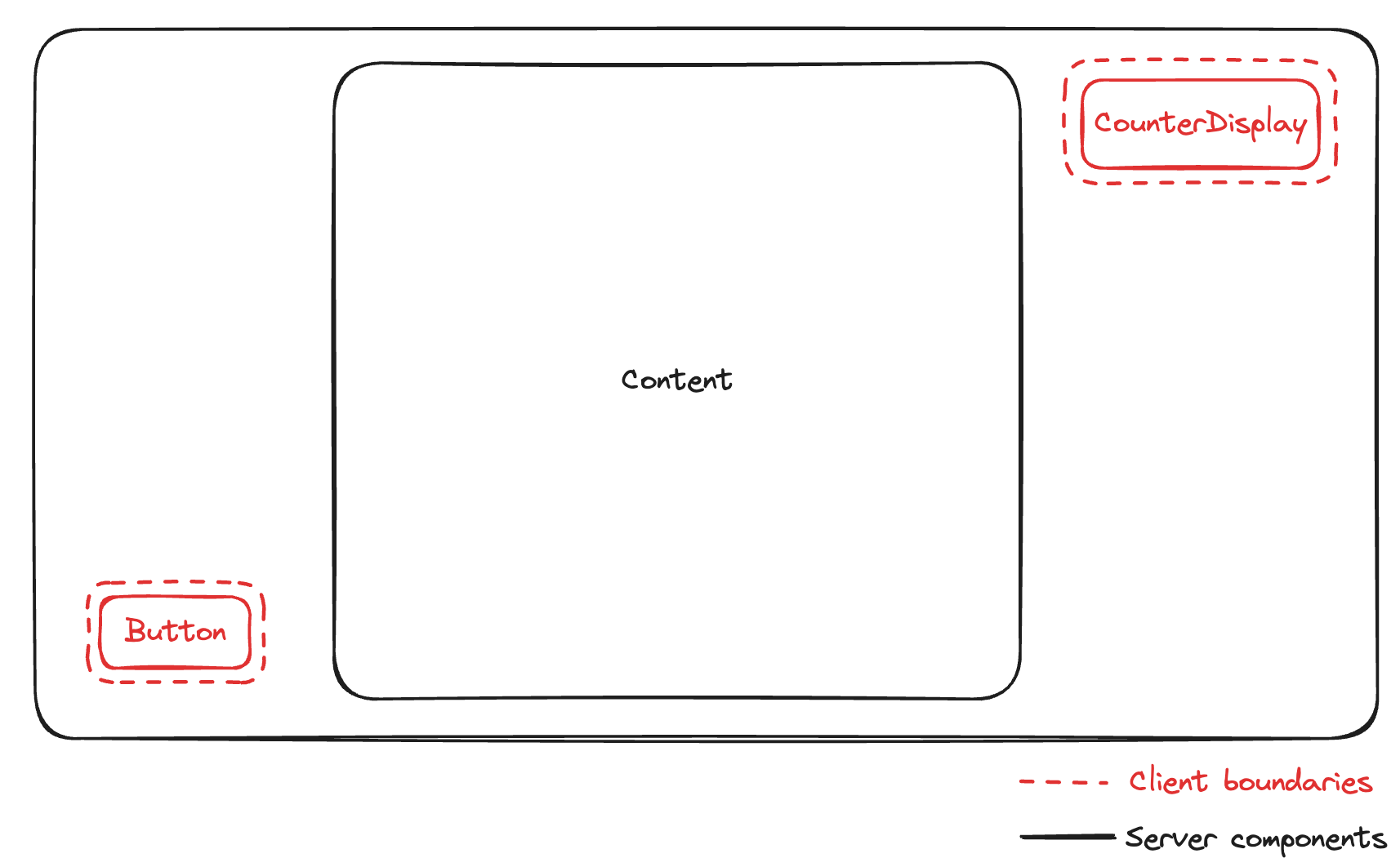
Wireframe of client boundaries

In a regular React application, this would typically be accomplished by lifting the state to a common ancestor component, allowing the button to update the state, which is then passed down to the counter display component.

However, the traditional approach may not be as straightforward in a Next.js application that heavily relies on server components, with client components scattered across the page. This blog post will explore three ways to facilitate communication between client components in Next.js, depending on where you want to store the state.

Lifting State to a Common Client Component

One approach to communicating between client components is to lift the state to a common client component. This could be a React context provider, a state management system like Zustand, or any other solution that allows you to share state across components.

The key aspect is that this wrapper component should be higher up in the tree (perhaps even in the layout) and accept server components as children. Next.js allows you to interleave client and server components as much as you want, as long as server components are passed to client components as props or as component children.

Here's how this approach might look in practice. First of all, we'd create a wrapper client component that holds the state:

// app/common-client-component/components/wrapper-component.tsx
"use client";

import { createContext, useState } from "react";

type WrapperContextValue = {
  counterValue: number;
  increaseCounter: () => void;
};

export const WrapperContext = createContext<WrapperContextValue>({
  counterValue: 0,
  increaseCounter: () => {},
});

export interface WrapperComponentProps {
  children?: React.ReactNode;
}

export default function WrapperComponent({ children }: WrapperComponentProps) {
  const [counterValue, setCounterValue] = useState(0);

  return (
    <WrapperContext.Provider
      value={{
        counterValue,
        increaseCounter: () => {
          setCounterValue((prev) => prev + 1);
        },
      }}
    >
      {children}
    </WrapperContext.Provider>
  );
}

This wrapper component can be included in the layout:

// app/common-client-component/layout.tsx
import WrapperComponent from "@/app/common-client-component/components/wrapper-component";

export default function CommonClientComponentLayout({
  children,
}: Readonly<{
  children: React.ReactNode;
}>) {
  return (
    <div>
      <h1>Common Client Component Layout</h1>
      <WrapperComponent>{children}</WrapperComponent>
    </div>
  );
}

Any server components can be rendered within the layout, potentially nesting them several levels deep. Finally, we'd create two client components, one for the button and one for the counter display:

// app/common-client-component/components/button.tsx
"use client";
import { WrapperContext } from "@/app/common-client-component/components/wrapper-component";
import { useContext } from "react";

export default function Button() {
  const { increaseCounter } = useContext(WrapperContext);

  return <button onClick={increaseCounter}>Click me</button>;
}
// app/common-client-component/components/counter-display.tsx
"use client";
import { useContext } from "react";
import { WrapperContext } from "@/app/common-client-component/components/wrapper-component";

export default function CounterDisplay() {
  const { counterValue } = useContext(WrapperContext);

  return (
    <div>
      <h2>Counter Display</h2>
      <p>Times clicked: {counterValue}</p>
    </div>
  );
}

The entire client and server component tree is rendered on the server, and the client components are then hydrated in the browser and initialized. From then on, the communication between the client components works just like in any regular React application.

Check out the page using this pattern in the embedded Stackblitz window below:

Using Query Params for State Management

Another approach is to use query params instead of a wrapper client component and store the state in the URL. In this scenario, you have two client components: the button and the counter display. The counter value (the state) is stored in a query param, such as counterValue.

The client components can read the current counter value using the useSearchParams hook. Once read, the useRouter hook can update the query param, effectively updating the counter value.

However, there's one gotcha to this approach. If a route is statically rendered, calling useSearchParams will cause the client component tree up to the closest Suspense boundary to be client-side rendered. Next.js recommends wrapping the client component that uses useSearchParams in a <Suspense/> boundary.

Here's an example of how this approach might look. The button reads the current counter value and updates it on click by using the router's replace function:

// app/using-query-params/components/button.tsx
"use client";
import { useSearchParams, useRouter } from "next/navigation";

export default function Button() {
  const router = useRouter();
  const searchParams = useSearchParams();
  const currentValue = searchParams.get("counterValue") || "0";

  const handleClick = () => {
    const newValue = parseInt(currentValue) + 1;
    const newSearchParams = new URLSearchParams(searchParams.toString());
    newSearchParams.set("counterValue", newValue.toString());
    router.replace(`?${newSearchParams.toString()}`);
  };

  return <button onClick={handleClick}>Increment</button>;
}

The counter display component is relatively simple, only reading the counter value:

// app/using-query-params/components/counter-display.tsx
"use client";
import { useSearchParams } from "next/navigation";

export default function CounterDisplay() {
  const searchParams = useSearchParams();
  const currentValue = searchParams.get("counterValue") || "0";

  return <div>Counter Value: {currentValue}</div>;
}

And here is the page that is a server component, hosting both of the above client components:

// app/using-query-params/page.tsx
import CounterDisplay from "@/app/using-query-params/components/counter-display";
import Button from "@/app/using-query-params/components/button";
import { Suspense } from "react";

export default function UsingQueryParamsPage() {
  return (
    <div>
      <h1>Using Query Params Page</h1>
      <Suspense>
        <CounterDisplay />
      </Suspense>
      <p>Some content goes here</p>
      <Suspense>
        <Button />
      </Suspense>
    </div>
  );
}

Feel free to check out the above page in the embedded Stackblitz below:

Storing State on the Server

The third approach is to store the state on the server. In this case, the counter display component accepts the counter value as a prop, where the counter value is passed by a parent server component that reads the counter value from the database.

The button component, when clicked, calls a server action that updates the counter value and calls revalidatePath() so that the counter value is refreshed, and consequently, the counter display component is re-rendered.

It's worth noting that in this approach, unless you need some interactivity in the counter display component, it doesn't need to be a client component – it can be purely server-rendered.

However, if both components need to be client components, here's an example of how this approach might look. First, we'll implement a server action that updates the counter value. We won't get into the mechanics of updating it, which in a real app would require a call to the database or an external API - so we're only commenting that part. After that, we revalidate the path so that the Next.js caches are purged, and the counter value is retrieved again in server components that read it.

// app/storing-state-on-server/actions/actions.ts
"use server";

import { revalidatePath } from "next/cache";

export async function incrementCounterAction() {
  // Call API/database to increment counter value

  // Revalidate the path to purge the caches and re-fetch the data
  revalidatePath("/storing-state-on-server");
}

The button is a simple client component that calls the above server action when clicked.

// app/storing-state-on-server/components/button.tsx
"use client";
import { incrementCounterAction } from "@/app/storing-state-on-server/actions/actions";

export default function Button() {
  const handleClick = async () => {
    await incrementCounterAction();
  };

  return <button onClick={handleClick}>Increment</button>;
}

The counter display component reads the counter value from the parent:

// app/storing-state-on-server/components/counter-display.tsx
"use client";

export type CounterDisplayProps = {
  counterValue: number;
};

export default function CounterDisplay({ counterValue }: CounterDisplayProps) {
  return <div>Counter Value: {counterValue}</div>;
}

While the parent is a server component that reads the counter value from the database or an external API.

// app/storing-state-on-server/page.tsx
import CounterDisplay from "@/app/storing-state-on-server/components/counter-display";
import Button from "@/app/storing-state-on-server/components/button";

async function getCounterValue() {
  return Promise.resolve(0); // This would be an API/database call in a real app
}

export default async function StoringStateOnServerPage() {
  const counterValue = await getCounterValue();
  return (
    <div>
      <h1>Storing State on Server Page</h1>
      <CounterDisplay counterValue={counterValue} />
      <p>Some content goes here</p>
      <Button />
    </div>
  );
}

This pattern can be seen in the embedded Stackblitz below:

Conclusion

Next.js is a powerful framework that offers various choices for implementing communication patterns between client components. Whether you lift state to a common client component, use query params for state management, or store the state on the server, Next.js provides all the tools you need to add a communication path between two separate client component boundaries.

We hope this blog post has been useful in demonstrating how to facilitate communication between client components in Next.js. Check out other Next.js blog posts we've written for more insights and best practices. You can also view the entire codebase for the above snippets on StackBlitz.

This Dot is a consultancy dedicated to guiding companies through their modernization and digital transformation journeys. Specializing in replatforming, modernizing, and launching new initiatives, we stand out by taking true ownership of your engineering projects.

We love helping teams with projects that have missed their deadlines or helping keep your strategic digital initiatives on course. Check out our case studies and our clients that trust us with their engineering.

You might also like

Vercel & React Native - A New Era of Mobile Development? cover image

Vercel & React Native - A New Era of Mobile Development?

Vercel & React Native - A New Era of Mobile Development? Jared Palmer of Vercel recently announced an acquisition that spiked our interest. Having worked extensively with both Next.js and Vercel, as well as React Native, we were curious to see what the appointment of Fernando Rojo, the creator of Solito, as Vercel's Head of Mobile, would mean for the future of React Native and Vercel. While we can only speculate on what the future holds, we can look closer at Solito and its current integration with Vercel. Based on the information available, we can also make some educated guesses about what the future might hold for React Native and Vercel. What is Solito? Based on a recent tweet by Guillermo Rauch, one might assume that Solito allows you to build mobile apps with Next.js. While that might become a reality in the future, Jamon Holmgren, the CTO of Infinite Red, added some context to the conversation. According to Jamon, Solito is a cross-platform framework built on top of two existing technologies: - For the web, Solito leverages Next.js. - For mobile, Solito takes advantage of Expo. That means that, at the moment, you can't build mobile apps using Next.js & Solito only - you still need Expo and React Native. Even Jamon, however, admits that even the current integration of Solito with Vercel is exciting. Let's take a closer look at what Solito is according to its official website: > This library is two things: > > 1. A tiny wrapper around React Navigation and Next.js that lets you share navigation code across platforms. > > 2. A set of patterns and examples for building cross-platform apps with React Native + Next.js. We can see that Jamon was right - Solito allows you to share navigation code between Next.js and React Native and provides some patterns and components that you can use to build cross-platform apps, but it doesn't replace React Native or Expo. The Cross-Platformness of Solito So, we know Solito provides a way to share navigation and some patterns between Next.js and React Native. But what precisely does that entail? Cross-Platform Hooks and Components If you look at Solito's documentation, you'll see that it's not only navigation you can share between Next.js and React Native. There are a few components that wrap Next.js components and make them available in React Native: - Link - a component that wraps Next.js' Link component and allows you to navigate between screens in React Native. - TextLink - a component that also wraps Next.js' Link component but accepts text nodes as children. - MotiLink - a component that wraps Next.js' Link component and allows you to animate the link using moti, a popular animation library for React Native. - SolitoImage - a component that wraps Next.js' Image component and allows you to display images in React Native. On top of that, Solito provides a few hooks that you can use for shared routing and navigation: - useRouter() - a hook that lets you navigate between screens across platforms using URLs and Next.js Url objects. - useLink() - a hook that lets you create Link components across the two platforms. - createParam() - a function that returns the useParam() and useParams() hooks which allow you to access and update URL parameters across platforms. Shared Logic The Solito starter project is structured as a monorepo containing: - apps/next - the Next.js application. - apps/expo or apps/native - the React Native application. - packages/app - shared packages across the two applications: - features - providers - navigation The shared packages contain the shared logic and components you can use across the two platforms. For example, the features package contains the shared components organized by feature, the providers package contains the shared context providers, and the navigation package includes the shared navigation logic. One of the key principles of Solito is gradual adoption, meaning that if you use Solito and follow the recommended structure and patterns, you can start with a Next.js application only and eventually add a React Native application to the mix. Deployments Deploying the Next.js application built on Solito is as easy as deploying any other Next.js application. You can deploy it to Vercel like any other Next.js application, e.g., by linking your GitHub repository to Vercel and setting up automatic deployments. Deploying the React Native application built on top of Solito to Expo is a little bit more involved - you cannot directly use the Github Action recommended by Expo without some modification as Solito uses a monorepo structure. The adjustment, however, is luckily just a one-liner. You just need to add the working-directory parameter to the eas update --auto command in the Github Action. Here's what the modified part of the Expo Github Action would look like: ` What Does the Future Hold? While we can't predict the future, we can make some educated guesses about what the future might hold for Solito, React Native, Expo, and Vercel, given what we know about the current state of Solito and the recent acquisition of Fernando Rojo by Vercel. A Competitor to Expo? One question that comes to mind is whether Vercel will work towards creating a competitor to Expo. While it's too early to tell, it's not entirely out of the question. Vercel has been expanding its offering beyond Next.js and static sites, and it's not hard to imagine that it might want to provide a more integrated, frictionless solution for building mobile apps, further bridging the gap between web and mobile development. However, Expo is a mature and well-established platform, and building a mobile app toolchain from scratch is no trivial task. It would be easier for Vercel to build on top of Expo and partner with them to provide a more integrated solution for building mobile apps with Next.js. Furthermore, we need to consider Vercel's target audience. Most of Vercel's customers are focused on web development with Next.js, and switching to a mobile-first approach might not be in their best interest. That being said, Vercel has been expanding its offering to cater to a broader audience, and providing a more integrated solution for building mobile apps might be a step in that direction. A Cross-Platform Framework for Mobile Apps with Next.js? Imagine a future where you write your entire application in Next.js — using its routing, file structure, and dev tools — and still produce native mobile apps for iOS and Android. It's unlikely such functionality would be built from scratch. It would likely still rely on React Native + Expo to handle the actual native modules, build processes, and distribution. From the developer’s point of view, however, it would still feel like writing Next.js. While this idea sounds exciting, it's not likely to happen in the near future. Building a cross-platform framework that allows you to build mobile apps with Next.js only would require a lot of work and coordination between Vercel, Expo, and the React Native community. Furthermore, there are some conceptual differences between Next.js and React Native that would need to be addressed, such as Next.js being primarily SSR-oriented and native mobile apps running on the client. Vercel Building on Top of Solito? One of the more likely scenarios is that Vercel will build on top of Solito to provide a more integrated solution for building mobile apps with Next.js. This could involve providing more components, hooks, and patterns for building cross-platform apps, as well as improving the deployment process for React Native applications built on top of Solito. A potential partnership between Vercel and Expo, or at least some kind of closer integration, could also be in the cards in this scenario. While Expo already provides a robust infrastructure for building mobile apps, Vercel could provide complementary services or features that make it easier to build mobile apps on top of Solito. Conclusion Some news regarding Vercel and mobile development is very likely on the horizon. After all, Guillermo Rauch, the CEO of Vercel, has himself stated that Vercel will keep raising the quality bar of the mobile and web ecosystems. While it's unlikely we'll see a full-fledged mobile app framework built on top of Next.js or a direct competitor to Expo in the near future, it's not hard to imagine that Vercel will provide more tools and services for building mobile apps with Next.js. Solito is a step in that direction, and it's exciting to see what the future holds for mobile development with Vercel....

Keeping Costs in Check When Hosting Next.js on Vercel cover image

Keeping Costs in Check When Hosting Next.js on Vercel

Vercel is usually the go-to platform for hosting Next.js apps, and not without reason. Not only are they one of the sponsors of Next.js, but their platform is very straightforward to use, not just for Next.js but for other frameworks, too. So it's no wonder people choose it more and more over other providers. Vercel, however, is a serverless platform, which means there are a few things you need to be aware of to keep your costs predictable and under control. This blog post covers the most important aspects of hosting a Next.js app on Vercel. Vercel's Pricing Structure Vercel's pricing structure is based on fixed and usage-based pricing, which is implemented through two big components of Vercel: the Developer Experience Platform (DX Platform) and the Managed Infrastructure. The DX Platform offers a monthly-billed suite of tools and services focused on building, deploying, and optimizing web apps. Think of it as the developer-focused interface on Vercel, which assists you in managing your app and provides team collaboration tools, deployment infrastructure, security, and administrative services. Additionally, it includes Vercel support. Because the DX Platform is developer-focused, it's also charged per seat on a monthly basis. The more developers have access to the DX Platform, the more you're charged. In addition to charging per seat, there are also optional, fixed charges for non-included, extra features. Observability Plus is one such example feature. The Managed Infrastructure, on the other hand, is what makes your app run and scale. It is a serverless platform priced per usage. Thanks to this infrastructure, you don't need to worry about provisioning, maintaining, or patching your servers. Everything is executed through serverless functions, which can scale up and down as needed. Although this sounds great, this is also one of the reasons many developers hesitate to adopt serverless; it may have unpredictable costs. One day, your site sees minimal traffic, and the next, it goes viral on Hacker News, leading to a sudden spike in costs. Vercel addresses this uncertainty by including a set amount of free serverless usage in each of its DX Platform plans. Once you exceed those limits, additional charges apply based on usage. Pricing Plans The DX Platform can be used in three different pricing plans on a team level. A team can represent a single person, a team within a company, or even a whole company. When creating a team on Vercel, this team can have one or more projects. The first of the three pricing plans is the Hobby plan, which is ideal for personal projects and experimentation. The Hobby plan is free and comes with some of the features and resources of the DX Platform and Managed Infrastructure out of the box, making it suitable for hosting small websites. However, note that the Hobby plan is limited to non-commercial, personal use only. The Pro plan is the most recommended for most teams and can be used for commercial purposes. At the time of this writing, it costs $20 per team member and comes with generous resources that support most teams. The third tier is the Enterprise plan, which is the most advanced and expensive option. This plan becomes necessary when your application requires specific compliance or performance features, such as isolated build infrastructure, Single Sign-On (SSO) for corporate user management or custom support with Service-Level Agreements. The Enterprise plan has a custom pricing model and is negotiated directly with Vercel. What Contributes to Usage Costs and Limiting Them Now that you've selected a plan for your team, you're ready to deploy Next.js. But how do you determine what contributes to your per-usage costs and ensure they stay within your plan limits? The Vercel pricing page has a detailed breakdown of the resource usage limits for each plan, which can help you understand what affects your costs. However, in this section, we've highlighted some of the most impactful factors on pricing that we've seen on many of our client projects. Number of Function Invocations Each time a serverless function runs, it counts as an invocation. Most of the processing on Vercel for your Next.js apps happens through serverless functions. Some might think that only API endpoints or server actions count as serverless function invocations, but this is not true. Every request that comes to the backend goes through a serverless function invocation, which includes: - Invoking server actions (server functions) - Invoking API routes (from the frontend, another system, or even within another serverless function) - Rendering a React server component tree (as part of a request to display a page) To give you an idea of the number of invocations included in a plan, the Pro plan includes 1 million invocations per month for free. After that, it costs $0.60 per million, which can total a significant amount for popular websites. To minimize serverless function invocations, focus on reducing any of the above points. For example: - Batch up server actions: If you have multiple server actions, such as downloading a file and increasing its download count, you can combine them into one server action. - Minimize calls to the backend: Closely related to the previous point, unoptimized client components can call the backend more than they need to, contributing to increased function invocation count. If needed, consider using a library such as useSwr or TanStack Query to keep your backend calls under control. - Use API routes correctly: Next.js recommends using API routes for external systems invoking your app. For instance, Contentful can invoke a blog post through a webhook without incurring additional invocations. However, avoid invoking API routes from server component tree renders, as this counts as at least two invocations. Reducing React server component renders is also possible. Not all pages need to be dynamic - convert dynamic routes to static content when you don’t expect them to change in real-time. On the client, utilize Next.js navigation primitives to use the client-side router cache. Middleware in Next.js runs before every request. Although this doesn't necessarily count as a function invocation (for edge middleware, this is counted in a separate bucket), it's a good idea to minimize the number of times it has to run. To minimize middleware invocations, limit them only to requests that require it, such as protected routes. For static asset requests, you can skip middleware altogether using matchers. For example, the matcher configuration below would prevent invoking the middleware for most static assets: ` Function Execution Time The duration your serverless function takes to execute counts as the execution time, and it impacts your end bill unless it's within the limits of your plan. This means that any inefficient code that takes longer to execute directly adds up to the total function invocation time. Many things can contribute to this, but one common pattern we've seen is not utilizing caching properly or under-caching. Next.js offers several caching techniques you can use, such as: - Using a data cache to prevent unnecessary database calls or API calls - Using memoization to prevent too many API or database calls in the same rendering pass Another reason, especially now in the age of AI APIs, is having a function run too long due to AI processing. In this case, what we could do is utilize some sort of queuing for long-processing jobs, or enable Fluid Compute, a recent feature by Vercel that optimizes function invocations and reusability. Bandwidth Usage The volume of data transferred between users and Vercel, including JavaScript bundles, RSC payload, API responses, and assets, directly contributes to bandwidth usage. In the Pro plan, you receive 1 TB/month of included bandwidth, which may seem substantial but can quickly be consumed by large Next.js apps with: - Large JavaScript bundles - Many images - Large API JSON payloads Image optimization is crucial for reducing bandwidth usage, as images are typically large assets. By implementing image optimization, you can significantly reduce the amount of data transferred. To further optimize your bandwidth usage, focus on using the Link component efficiently. This component performs automatic prefetch of content, which can be beneficial for frequently accessed pages. However, you may want to disable this feature for infrequently accessed pages. The Link component also plays a role in reducing bandwidth usage, as it aids in client-side navigation. When a page is cached client-side, no request is made when the user navigates to it, resulting in reduced bandwidth usage. Additionally, API and RSC payload responses count towards bandwidth usage. To minimize this impact, always return only the minimum amount of data necessary to the end user. Image Transformations Every time Vercel transforms an image from an unoptimized image, this counts as an image transformation. After transformation, every time an optimized image is written to Vercel's CDN network and then read by the user's browser, this counts as an image cache read and an image cache write, respectively. The Pro plan includes 10k transformations per month, 600k CDN cache reads, and 200k CDN cache writes. Given the high volume of image requests in many apps, it's worth checking if the associated costs can be reduced. Firstly, not every image needs to be transformed. Certain types of images, such as logos and icons, small UI elements (e.g., button graphics), vector graphics, and other pre-optimized images you may have optimized yourself already, don't require transformation. You can store these images in the public folder and use the unoptimized property with the Image component to mark them as non-transformable. Another approach is to utilize an external image provider like Cloudinary or AWS CloudFront, which may have already optimized the images. In this case, you can use a custom image loader to take advantage of their optimizations and avoid Vercel's image transformations. Finally, Next.js provides several configuration options to fine-tune image transformation: - images.minimumCacheTTL: Controls the cache duration, reducing the need for rewritten images. - images.formats: Allows you to limit eligible image formats for transformation. - images.remotePatterns: Defines external sources for image transformation, giving you more control over what's optimized. - images.quality: Enables you to set the image quality for transformed images, potentially reducing bandwidth usage. Monitoring The "Usage" tab on the team page in Vercel provides a clear view of your team's resource usage. It includes information such as function invocation counts, function durations, and fast origin transfer amounts. You can easily see how far you are from reaching your team's limit, and if you're approaching it, you'll see the amount. This page is a great way to monitor regularity. However, you don't need to check it constantly. Vercel offers various aspects of spending management, and you can set alert thresholds to get notified when you're close to or exceed your limit. This helps you proactively manage your spending and avoid unexpected charges. One good feature of Vercel is its ability to pause projects when your spending reaches a certain point, acting as an "emergency break" in the case of a DDoS attack or a very unusual spike in traffic. However, this will stop the production deployment, and the users will not be able to use your site, but at least you won't be charged for any extra usage. This option is enabled by default. Conclusion Hosting a Next.js app on Vercel offers a great developer experience, but it's also important to consider how this contributes to your end bill and keep it under control. Hopefully, this blog post will clear up some of the confusion around pricing and how to plan, optimize, and monitor your costs. We hope you enjoyed this blog post. Be sure to check out our other blog posts on Next.js for more in-depth coverage of different features of this framework....

Integrating Next.js with New Relic cover image

Integrating Next.js with New Relic

Integrating Next.js with New Relic When it comes to application monitoring, New Relic is genuinely one of the veterans in the market. Founded in 2008, it offers a large set of tools designed for developers to help them analyze application performance, troubleshoot problems, and gain insight into user behavior through real-time analytics. We needed to integrate New Relic's application monitoring with a modern Next.js app built on top of the app router. This blog post will explain your options if you want to do the same in your project. Please keep in mind that depending on when you read this blog post, there may be some advances in how New Relic works with Next.js. You can always refer to the official New Relic website for up-to-date documentation. The approach is also different, depending on whether you use Vercel's managed Next.js hosting (or any other provider that is lambda-based) or self-host Next.js on an alternative provider such as Fly.io. We'll start with the typical steps you need to do for both ways of deploying; then we'll continue with the self-hosted option, which uses a complete set of features from New Relic, and finish with Vercel where we recommend the OpenTelemetry integration for now. Common Prerequisite Steps First, let's install the necessary packages. These were built by New Relic and are needed whether you self-host your Next.js app or host it on Vercel. ` The next thing you'll want to do is define your app name. The name will be different depending on the environment the app is running in, such as a local environment, staging, or production. This will ensure that the data you send to New Relic is always tagged with a proper app name and will not be mixed between environments. An environment-changing parameter, such as the app name, should always be included in an environment variable. In your local environment, that would be in .env.local, while staging/production or any other hosted environments would be configured in the provider. ` To get full coverage with New Relic, in Next.js, we need to cover the parts running on the client (in the browser) and on the server. The server-running part is different on Vercel's managed hosting, where all of the logic is executed within lambdas, and self-hosting variants, where the server logic is executed on a Node.js server. The client part is configured by going to the New Relic dashboard and clicking "Add Data" / "Browser Monitoring". Choose "place a JavaScript snippet in frontend code," name it the same name you used in the environment variable above, click "Continue" to the last step, and copy the part between the script tags: ` Then paste it to a variable inside any module of your code. For example, this is how we did it: ` Now, create a component that will use this script and put it to Next's Script component. Then you can use the component in your root layout: ` There are several things to note here. First, we need to set a unique ID for the Script component for Next.js to track and optimize the script. We also need to set the strategy to beforeInteractive so that the New Relic script is added to the document’s head element. Finally, we use some environment helper variables. IS_PRODUCTION and IS_STAGING are just helper variables that read the environment variables to determine if we are in a local environment, staging, or production. Now you can create an app router error page and report any uncaught errors to New Relic: ` With this in place, the client part is covered, and you should start seeing data in the New Relic dashboard under "All Entities" / "Browser Applications." Let's now focus on the server part, with both a self-hosted option and Vercel. Self-Hosting Next.js If you self-host Next.js, It will typically run through a Node server (containerized or not), meaning you can fully utilize New Relic's APM agent. Start by adding this to the Next.js config (next.config.js) to mark the newrelic package as external, otherwise you would not be able to import it. ` The next step that New Relic recommends is to copy the newrelic.js file from the newrelic library to the root of the folder. However, we want to keep our project root clean, and we'll store the file in o11y/newrelic.js (“o11y” is an abbreviation for observability). This will also demonstrate the configuration needed to make this possible. This file, by default, will look something like this. ` As you can see, some environment variables are involved, such as NEW_RELIC_APP_NAME and NEW_RELIC_LICENSE_KEY. These environment variables will be needed when the New Relic agent starts up. The trick here is that the agent doesn't start up with your app but *earlier* by preloading the library through another environment variable, NODE_OPTIONS. On the server, that would be done by modifying the start script to this: ` This ensures the agent is preloaded before starting the app, and the rest of the environment variables (such as NEW_RELIC_APP_NAME and NEW_RELIC_LICENSE_KEY) should already exist. Making sure this works in local development is not that easy due to different stages of loading environment variables. The environment variables from .env.local are loaded by the framework, which is too late for the New Relic agent (which is preloaded by the Node process). However, it is possible with a trick. First, add the following new environment variables to .env.local: ` (We have not mentioned NEW_RELIC_HOME so far, but the New Relic agent implicitly uses it to locate the newrelic.js file. We need to specify that since we moved it to the o11y folder.) Next, install the nodenv package. ` The nodenv package provides a cross-platform way of preloading environment variables before we start the Node process. If we provide it with the .env.local file, this means all of the environment variables from that file will be available to the New Relic agent! Change the scripts in package.json: ` And that's it. If you now start the local server using the dev command, nodenv will make environment variables available to the Node process. The Node process will preload the New Relic agent (because we have NODE_OPTIONS in .local.env), the agent will read all the environment variables needed by newrelic.js, and everything will work as expected. The first thing you might notice is the creation of the newrelic_agent.log. This is just a log file by the agent which you can use to troubleshoot if the agent is not working correctly. You can safely add this file to .gitignore. From this point on, the server-side part of the app can utilize New Relic's API (such as noticeError and recordLogEvent) and the agent will automatically be recording transactions made through the server. The data should be visible in the New Relic dashboard, under "All Entities" / "Services - APM". This is how you would log an error in your server action, for example: ` The full source of this type of integration is available on StackBlitz. Using Vercel's Managed Next.js Hosting Using the New Relic APM agent on Vercel is currently not possible, as the server part of Next.js runs within lambdas, and not within a typical Node server as in the self-hosted option. In the future, this may be possible. At the moment, the only way to integrate Vercel and New Relic is by using the Vercel OpenTelemetry collector, which is only available for some plans. The first step is to enable the integration in Vercel's dashboard and then install the following packages: ` Create an instrumentation.ts file in the root of your project and add the following code: ` In the the Next.js config (next.config.js), add: ` The OpenTelemetry integration does not work locally, hence the above conditional check. With the above configuration, the collected OpenTelemetry data should be visible in the New Relic dashboard under "All Entities" / "Services - OpenTelemetry". Optionally, Logging via New Relic API When using the Vercel OpenTelemetry integration, there is no easy way to submit custom logs to New Relic. New Relic offers a logging API, however, so to send custom logs from your backend, you could use a logger such as Winston, which has good library support for custom transports, such as the one for New Relic. Install the following packages: ` Then create a logger.ts file with the following code: ` NewRelicTransport utilizes the New Relic logging API to send application logs. Now you can use the serverLogger in your backend code, from server components to server actions. Conclusion As you can see, various options exist for integrating New Relic with the modern, app-router-based Next.js. Sadly, at the time of writing, no one-size-fits-all solution works equally for all hosting options, as Vercel's managed Next.js platform is still relatively young, and so is the app router in Next.js. If you liked this blog post, feel free to browse our other Next.js blog posts for more tips and tricks in other areas of the Next.js ecosystem....

The simplicity of deploying an MCP server on Vercel cover image

The simplicity of deploying an MCP server on Vercel

The current Model Context Protocol (MCP) spec is shifting developers toward lightweight, stateless servers that serve as tool providers for LLM agents. These MCP servers communicate over HTTP, with OAuth handled clientside. Vercel’s infrastructure makes it easy to iterate quickly and ship agentic AI tools without overhead. Example of Lightweight MCP Server Design At This Dot Labs, we built an MCP server that leverages the DocuSign Navigator API. The tools, like `get_agreements`, make a request to the DocuSign API to fetch data and then respond in an LLM-friendly way. ` Before the MCP can request anything, it needs to guide the client on how to kick off OAuth. This involves providing some MCP spec metadata API endpoints that include necessary information about where to obtain authorization tokens and what resources it can access. By understanding these details, the client can seamlessly initiate the OAuth process, ensuring secure and efficient data access. The Oauth flow begins when the user's LLM client makes a request without a valid auth token. In this case they’ll get a 401 response from our server with a WWW-Authenticate header, and then the client will leverage the metadata we exposed to discover the authorization server. Next, the OAuth flow kicks off directly with Docusign as directed by the metadata. Once the client has the token, it passes it in the Authorization header for tool requests to the API. ` This minimal set of API routes enables me to fetch Docusign Navigator data using natural language in my agent chat interface. Deployment Options I deployed this MCP server two different ways: as a Fastify backend and then by Vercel functions. Seeing how simple my Fastify MCP server was, and not really having a plan for deployment yet, I was eager to rewrite it for Vercel. The case for Vercel: * My own familiarity with Next.js API deployment * Fit for architecture * The extremely simple deployment process * Deploy previews (the eternal Vercel customer conversion feature, IMO) Previews of unfamiliar territory Did you know that the MCP spec doesn’t “just work” for use as ChatGPT tooling? Neither did I, and I had to experiment to prove out requirements that I was unfamiliar with. Part of moving fast for me was just deploying Vercel previews right out of the CLI so I could test my API as a Connector in ChatGPT. This was a great workflow for me, and invaluable for the team in code review. Stuff I’m Not Worried About Vercel’s mcp-handler package made setup effortless by abstracting away some of the complexity of implementing the MCP server. It gives you a drop-in way to define tools, setup https-streaming, and handle Oauth. By building on Vercel’s ecosystem, I can focus entirely on shipping my product without worrying about deployment, scaling, or server management. Everything just works. ` A Brief Case for MCP on Next.js Building an API without Next.js on Vercel is straightforward. Though, I’d be happy deploying this as a Next.js app, with the frontend features serving as the documentation, or the tools being a part of your website's agentic capabilities. Overall, this lowers the barrier to building any MCP you want for yourself, and I think that’s cool. Conclusion I'll avoid quoting Vercel documentation in this post. AI tooling is a critical component of this natural language UI, and we just want to ship. I declare Vercel is excellent for stateless MCP servers served over http....

Let's innovate together!

We're ready to be your trusted technical partners in your digital innovation journey.

Whether it's modernization or custom software solutions, our team of experts can guide you through best practices and how to build scalable, performant software that lasts.

Prefer email? hi@thisdot.co