Skip to content

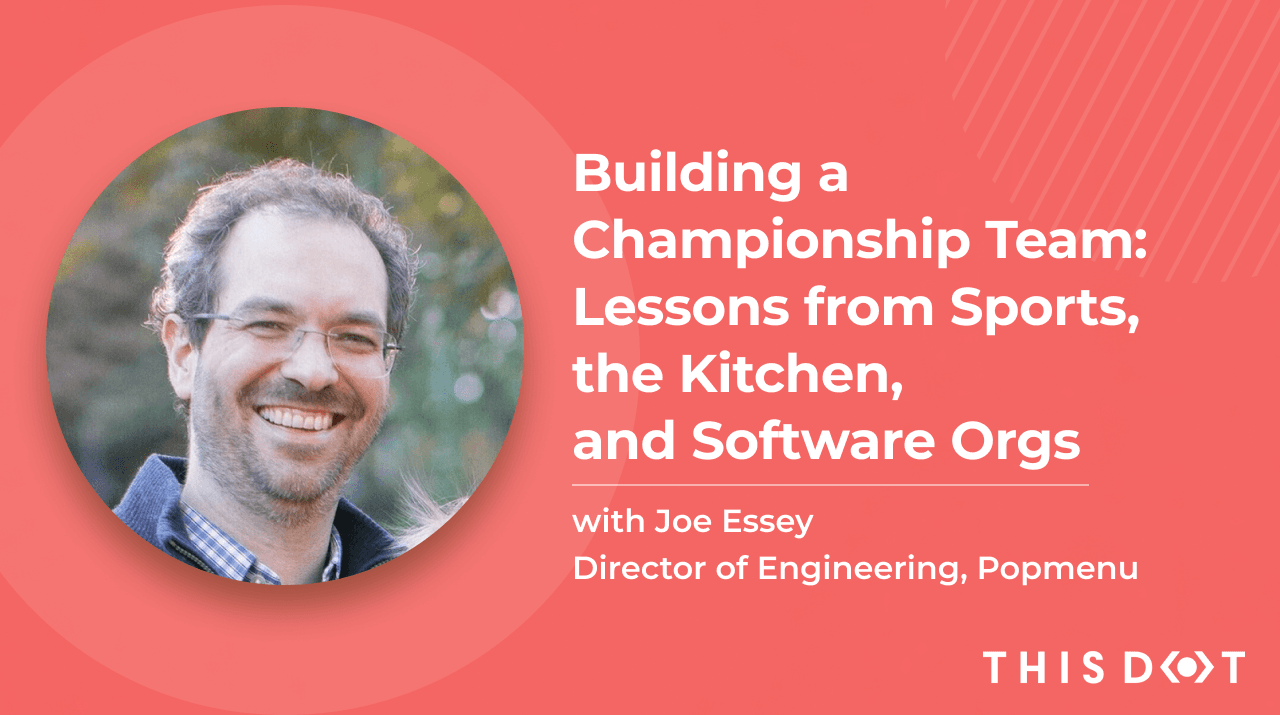
Building a Championship Team: Lessons from Sports, the Kitchen, and Software Orgs with Joe Essey, Director of Engineering at Popmenu

Building a Championship Team: Lessons from Sports, the Kitchen, and Software Orgs with Joe Essey, Director of Engineering at Popmenu

This article was written over 18 months ago and may contain information that is out of date. Some content may be relevant but please refer to the relevant official documentation or available resources for the latest information.

In this episode of the Engineering Leadership podcast, Rob Ocel sits down with Joe Essey, the Director of Engineering at Popmenu, to discuss the key elements of creating a high-performing team environment. Drawing from his experience in the restaurant industry and his time at Liberty Mutual Insurance, Salesloft, and Popmenu, Joe provides insights into fostering a successful team dynamic.

One of the fundamental aspects Joe highlights is the importance of peer accountability. He emphasizes that team members should hold each other responsible for their actions and outcomes, creating a culture of ownership and continuous improvement. This not only helps in achieving individual goals but also contributes to the overall success of the team.

Another crucial factor Joe emphasizes is the establishment of shared trust within the team. Trust is the foundation upon which effective collaboration and communication are built. When team members trust each other, they are more likely to openly share ideas, provide constructive feedback, and work towards common objectives.

A clear definition of success is also vital in creating a high-performing team environment. Joe stresses the significance of setting clear goals and expectations, ensuring that everyone is aligned and working towards a common purpose. This clarity helps in avoiding confusion and enables team members to focus their efforts on achieving the desired outcomes.

Joe also highlights the importance of having a good pipeline and the right people in place. A strong talent acquisition process ensures that the team is composed of individuals who possess the necessary skills and mindset to excel in their roles. By carefully selecting team members, organizations can create a cohesive and high-performing team.

Joe Essey's insights shed light on the key elements required to create a high-performing team environment. Peer accountability, shared trust, and a clear definition of success are all crucial factors in fostering a culture of excellence. Additionally, having a strong talent pipeline and the right people in place further contribute to the success of the team. Joe's story of Jake's rapid promotion serves as a motivating example of the potential for growth within such an environment.
This Dot is a consultancy dedicated to guiding companies through their modernization and digital transformation journeys. Specializing in replatforming, modernizing, and launching new initiatives, we stand out by taking true ownership of your engineering projects.

We love helping teams with projects that have missed their deadlines or helping keep your strategic digital initiatives on course. Check out our case studies and our clients that trust us with their engineering.

You might also like

“ChatGPT knows me pretty well… but it drew me as a white man with a man bun.” – Angie Jones on AI Bias, DevRel, and Block’s new open source AI agent “goose” cover image

“ChatGPT knows me pretty well… but it drew me as a white man with a man bun.” – Angie Jones on AI Bias, DevRel, and Block’s new open source AI agent “goose”

Angie Jones is a veteran innovator, educator, and inventor with over twenty years of industry experience and twenty-seven digital technology patents both domestically and internationally. As the VP of Developer Relations at Block, she facilitates developer training and enablement, delivering tools for developer users and open source contributors. However, her educational work doesn’t end with her day job. She is also a contributor to multiple books examining the intersection of technology and career, including *DevOps: Implementing Cultural Change*, and *97 Things Every Java Programmer Should Know*, and is an active speaker in the global developer conference circuit. With the release of Block’s new open source AI agent “goose”, Angie drives conversations around AI’s role in developer productivity, ethical practices, and the application of intelligent tooling. We had the chance to talk with her about the evolution of DevRel, what makes a great leader, emergent data governance practices, women who are crushing it right now in the industry, and more: Developer Advocacy is Mainstream A decade ago, Developer Relations (DevRel) wasn’t the established field it is today. It was often called Developer Evangelism, and fewer companies saw the value in having engineers speak directly to other engineers. > “Developer Relations was more of a niche space. It’s become much more mainstream these days with pretty much every developer-focused company realizing that the best way to reach developers is with their peers.” That shift has opened up more opportunities for engineers who enjoy teaching, community-building, and breaking down complex technical concepts. But because DevRel straddles multiple functions, its place within an organization remains up for debate—should it sit within Engineering, Product, Marketing, or even its own department? There’s no single answer, but its cross-functional nature makes it a crucial bridge between technical teams and the developers they serve. Leadership Is Not an Extension of Engineering Excellence Most engineers assume that excelling as an IC is enough to prepare them for leadership, but Angie warns that this is a common misconception. She’s seen firsthand how technical skills don’t always equate to strong leadership abilities—we’ve all worked under leaders who made us wonder *how they got there*. When she was promoted into leadership, Angie was determined not to become one of those leaders: > “This required humility. Acknowledging that while I was an expert in one area, I was a novice in another.” Instead of assuming leadership would come naturally, she took a deliberate approach to learning—taking courses, reading books, and working with executive coaches to build leadership skills the right way. Goose: An Open Source AI Assistant That Works for You At Block, Angie is working on a tool called goose, an open-source AI agent that runs locally on your machine. Unlike many AI assistants that are locked into specific platforms, goose is designed to be fully customizable: > “You can use your LLM of choice and integrate it with any API through the Model Context Protocol (MCP).” That flexibility means goose can be tailored to fit developers’ workflows. Angie gives an example of what this looks like in action: > “Goose, take this Figma file and build out all of the components for it. Check them into a new GitHub repo called @org/design-components and send a message to the #design channel in Slack informing them of the changes.” And just like that, it’s done— no manual intervention required. The Future of Data Governance As AI adoption accelerates, data governance has become a top priority for companies. Strong governance requires clear policies, security measures, and accountability. Angie points out that organizations are already making moves in this space: > “Cisco recently launched a product called AI Defense to help organizations enhance their data governance frameworks and ensure that AI deployments align with established data policies and compliance requirements.” According to Angie, in the next five years, we can expect more structured frameworks around AI data usage, especially as businesses navigate privacy concerns and regulatory compliance. Bias in AI Career Tools: Helping or Hurting? AI-powered resume screeners and promotion predictors are becoming more common in hiring, but are they helping or hurting underrepresented groups? Angie’s own experience with AI bias was eye-opening: > “I use ChatGPT every day. It knows me pretty well. I asked it to draw a picture of what it thinks my current life looks like, and it drew me as a white male (with a man bun).” When she called it out, the AI responded: > “No, I don’t picture you that way at all, but it sounds like the illustration might’ve leaned into the tech stereotype aesthetic a little too much.” This illustrates a bigger problem— AI often reflects human biases at scale. However, there are emerging solutions, such as identity masking, which removes names, race, and gender markers so that only skills are evaluated. > “In scenarios like this, minorities are given a fairer shot.” It’s a step toward a more equitable hiring process, but it also surfaces the need for constant vigilance in AI development to prevent harmful biases. Women at the Forefront of AI Innovation While AI is reshaping nearly every industry, women are playing a leading role in its development. Angie highlights several technologists: > “I’m so proud to see women are already at the forefront of AI innovation. I see amazing women leading AI research, training, and development such as Mira Murati, Timnit Gebru, Joelle Pineau, Meredith Whittaker, and even Block’s own VP of Data & AI, Jackie Brosamer.” These women are influencing not just the technical advancements in AI but also the ethical considerations that come with it. Connect with Angie Angie Jones is an undeniable pillar of the online JavaScript community, and it isn’t hard to connect with her! You can find Angie on X (Twitter), Linkedin, or on her personal site (where you can also access her free Linkedin Courses). Learn more about goose by Block. Sticker Illustration by Jacob Ashley...

AI Is Speeding Up Development. But Where Are the New Bottlenecks? cover image

AI Is Speeding Up Development. But Where Are the New Bottlenecks?

AI is accelerating development, but it’s also exposing everything else that’s broken. At the Leadership Exchange, leaders unpacked how AI is reshaping the SDLC and what organizations need to address beyond just coding to make adoption successful. Moderated by Rob Ocel, VP of Innovation at This Dot Labs, the panel featured Itai Gerchikov at Anthropic and Harald Kirschner, Principal Product Manager for GitHub Copilot & VS Code at Microsoft. Panelists explored the current state of AI adoption across the software development lifecycle and shared practical insights into how organizations can effectively integrate AI tools. Panelists discussed how companies are investing in AI tools, skills, and managed competency programs to support developers. While AI can dramatically accelerate coding, the panel emphasized that adoption affects every stage of the SDLC. Bottlenecks now appear in testing, DevOps, product delivery, and marketing as AI speeds up development. Organizations that address technical debt and process inefficiencies are better positioned to extract maximum value from AI tools. The conversation also focused on opportunities and risks. Security, governance, and workforce education were highlighted as critical factors for adoption. Panelists stressed that AI initiatives should be aligned with broader business goals rather than pursued in isolation. They noted that companies experimenting at the cutting edge need to consider organizational readiness just as carefully as technical capabilities. Panelists also explored how leading organizations are navigating the early stages of adoption. Those ahead of the curve are using structured experimentation, prioritizing process improvements, and continuously evaluating outcomes to refine their AI strategies. Learning from these early adopters allows other organizations to anticipate emerging trends and prepare for the next phase of AI adoption rather than simply replicating past approaches. Key Takeaways - Investing in AI skills and tools should be done thoughtfully, with clear alignment to business objectives. - Examining the full SDLC helps identify bottlenecks that AI may accelerate or expose. - Organizations can gain a competitive advantage by learning from early adopters and planning for where AI adoption is heading. AI adoption is not just a technical initiative; it is a strategic transformation that requires attention to people, process, and technology. Organizations that balance innovation with operational discipline will be best positioned to capture the full potential of AI across the software lifecycle. Seeing similar challenges in your own SDLC? Let’s compare notes. Join us at an upcoming Leadership Exchange or reach out to continue the conversation. Tracy can be reached at tlee@thisdot.co....

This Dot AI Field Notes - Anatomy of a Coding Harness cover image

This Dot AI Field Notes - Anatomy of a Coding Harness

A coding agent is not magic, it’s a loop. We call this a harness. The harness is a deterministic layer of code that wraps an LLM. Claude Code is a harness. Codex is a harness. Pi is a harness. The harness, on initialization, provides to the LLM a system prompt defining all tools the harness implements for the LLM. Without the harness, you cannot read or modify files on the user’s local filesystem without them having to copy-and-pasting by hand. The harness is the final place where engineers can customize how coding agents do work before the LLM takes over. Think of the LLM as a train and the harness as the rails the train rides on. Below… one full task executed by a harness, traced step by step....

Making AI Deliver: From Pilots to Measurable Business Impact cover image

Making AI Deliver: From Pilots to Measurable Business Impact

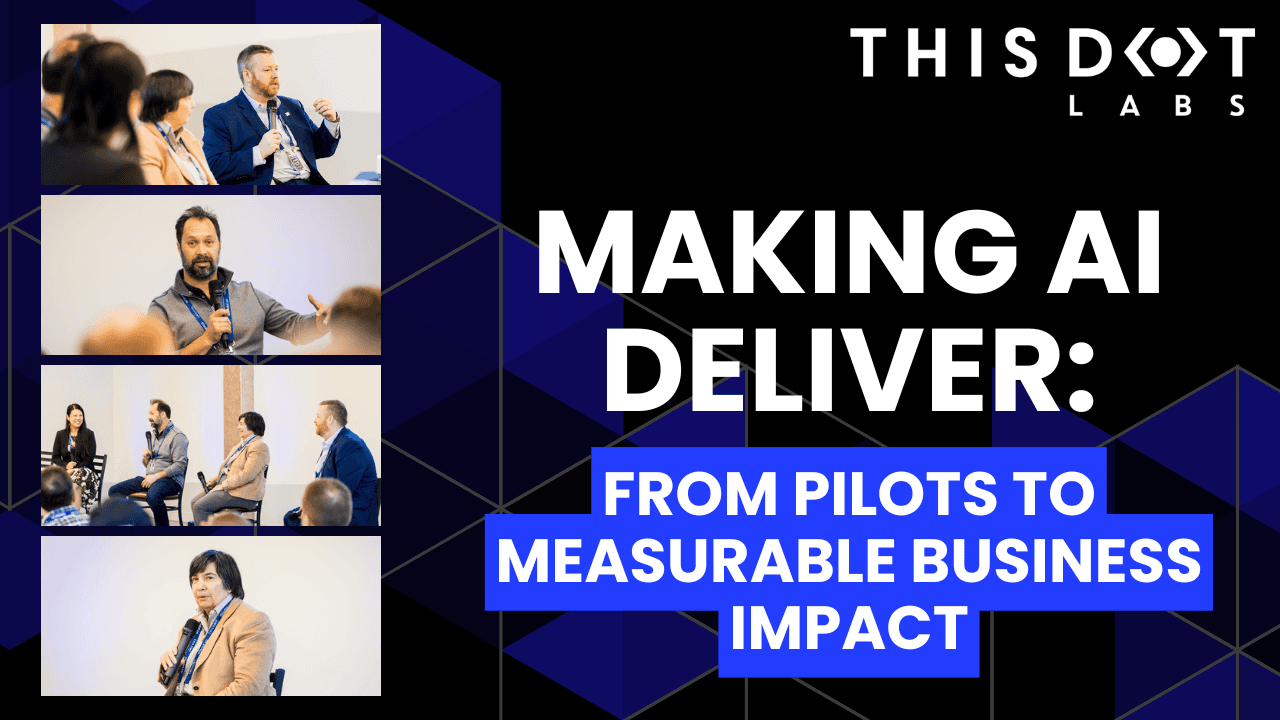
A lot of organizations have experimented with AI, but far fewer are seeing real business results. At the Leadership Exchange, this panel focused on what it actually takes to move beyond experimentation and turn AI into measurable ROI. Over the past few years, many organizations have experimented with AI, but the challenge today is translating experimentation into measurable business value. Moderated by Tracy Lee, CEO at This Dot Labs, panelists featured Dorren Schmitt, Vice President IT Strategy & Innovation at Allen Media Group, Greg Geodakyan, CTO at Client Command, and Elliott Fouts, CAIO & CTO at This Dot Labs. Panelists discussed how companies are moving from early AI experiments to initiatives that deliver real results. They began by examining how experimentation has evolved over the past year. While many organizations did not fully utilize AI experimentation budgets in 2025, 2026 is showing a shift toward more intentional investment. Structured budgets and clearly defined frameworks are enabling companies to explore AI strategically and identify initiatives with high potential impact. The conversation then turned to alignment and ROI. Panelists highlighted the importance of connecting AI projects to corporate strategy and leadership priorities. Ensuring that AI initiatives translate into operational efficiency, productivity gains, and measurable business impact is essential. Companies that successfully align AI efforts with organizational goals are better equipped to demonstrate tangible outcomes from their investments. Moving from pilots and proofs of concept to production was another major focus. Governance, prioritization, and workflow integration were cited as essential for scaling AI initiatives. One panelist shared that out of nine proofs of concept, eight successfully launched, resulting in improvements in quality and operational efficiency. Panelists also explored the future of AI within organizations, including the potential for agentic workflows and reduced human-in-the-loop processes. New capabilities are emerging that extend beyond coding tasks, reshaping how teams collaborate and how work is structured across departments. Key Takeaways - Structured experimentation and defined budgets allow organizations to explore AI strategically and safely. - Alignment with business priorities is essential for translating AI capabilities into measurable outcomes. - Governance and workflow integration are critical to moving AI initiatives from pilot stages to production deployment. Successfully leveraging AI requires a balance between experimentation, strategic alignment, and operational discipline. Organizations that approach AI as a structured, measurable initiative can capture meaningful results and unlock new opportunities for innovation. Curious how your organization can move from AI experimentation to real impact? Let’s talk. Reach out to continue the conversation or join us at an upcoming Leadership Exchange. Tracy can be reached at tlee@thisdot.co....

Let's innovate together!

We're ready to be your trusted technical partners in your digital innovation journey.

Whether it's modernization or custom software solutions, our team of experts can guide you through best practices and how to build scalable, performant software that lasts.

Prefer email? hi@thisdot.co