Skip to content

AI Is Speeding Up Development. But Where Are the New Bottlenecks?

AI Is Speeding Up Development. But Where Are the New Bottlenecks?

AI is accelerating development, but it’s also exposing everything else that’s broken.

At the Leadership Exchange, leaders unpacked how AI is reshaping the SDLC and what organizations need to address beyond just coding to make adoption successful.

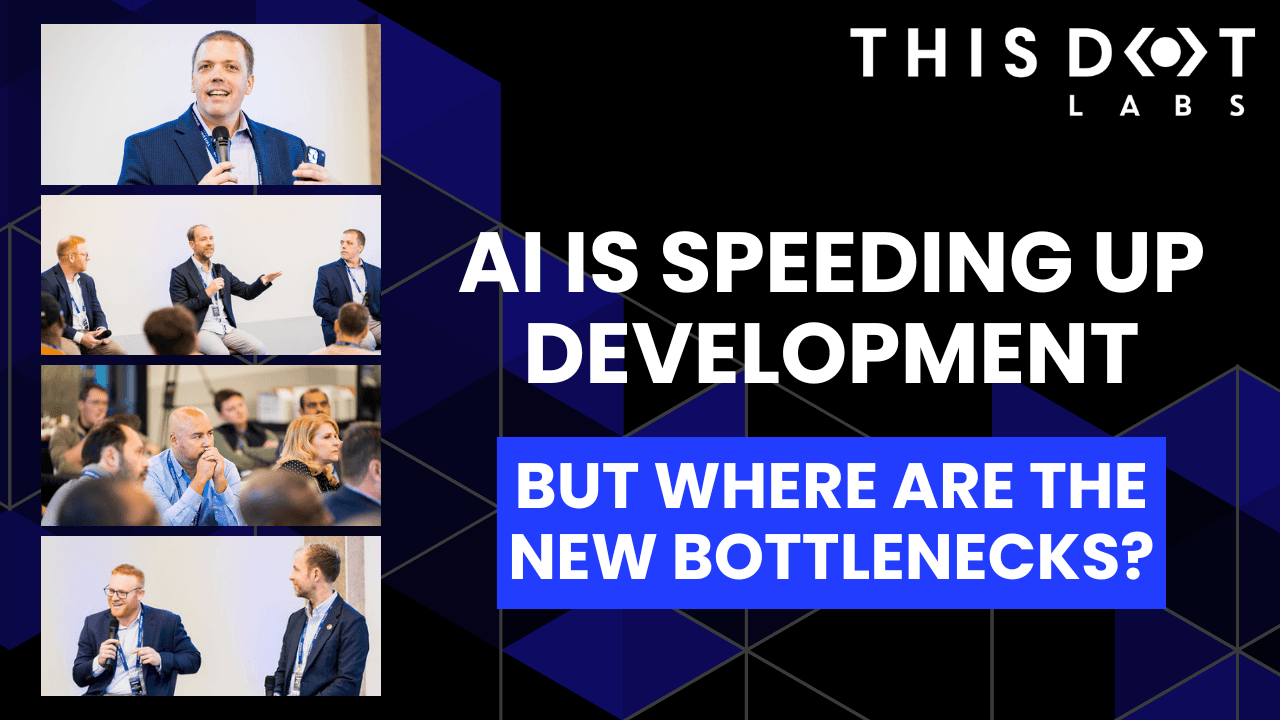
Moderated by Rob Ocel, VP of Innovation at This Dot Labs, the panel featured Itai Gerchikov at Anthropic and Harald Kirschner, Principal Product Manager for GitHub Copilot & VS Code at Microsoft. Panelists explored the current state of AI adoption across the software development lifecycle and shared practical insights into how organizations can effectively integrate AI tools.

Panelists discussed how companies are investing in AI tools, skills, and managed competency programs to support developers. While AI can dramatically accelerate coding, the panel emphasized that adoption affects every stage of the SDLC. Bottlenecks now appear in testing, DevOps, product delivery, and marketing as AI speeds up development. Organizations that address technical debt and process inefficiencies are better positioned to extract maximum value from AI tools.

The conversation also focused on opportunities and risks. Security, governance, and workforce education were highlighted as critical factors for adoption. Panelists stressed that AI initiatives should be aligned with broader business goals rather than pursued in isolation. They noted that companies experimenting at the cutting edge need to consider organizational readiness just as carefully as technical capabilities.

Panelists also explored how leading organizations are navigating the early stages of adoption. Those ahead of the curve are using structured experimentation, prioritizing process improvements, and continuously evaluating outcomes to refine their AI strategies. Learning from these early adopters allows other organizations to anticipate emerging trends and prepare for the next phase of AI adoption rather than simply replicating past approaches.

Key Takeaways

  • Investing in AI skills and tools should be done thoughtfully, with clear alignment to business objectives.
  • Examining the full SDLC helps identify bottlenecks that AI may accelerate or expose.
  • Organizations can gain a competitive advantage by learning from early adopters and planning for where AI adoption is heading.

AI adoption is not just a technical initiative; it is a strategic transformation that requires attention to people, process, and technology. Organizations that balance innovation with operational discipline will be best positioned to capture the full potential of AI across the software lifecycle.

Seeing similar challenges in your own SDLC? Let’s compare notes. Join us at an upcoming Leadership Exchange or reach out to continue the conversation. Tracy can be reached at tlee@thisdot.co.

This Dot is a consultancy dedicated to guiding companies through their modernization and digital transformation journeys. Specializing in replatforming, modernizing, and launching new initiatives, we stand out by taking true ownership of your engineering projects.

We love helping teams with projects that have missed their deadlines or helping keep your strategic digital initiatives on course. Check out our case studies and our clients that trust us with their engineering.

You might also like

What does it actually look like to build software with AI today? Not in theory, but in practice. cover image

What does it actually look like to build software with AI today? Not in theory, but in practice.

What does it actually look like to build software with AI today? Not in theory, but in practice. At the Leadership Exchange, this was the question at the center of the Developer Panel, where leaders from across the industry unpacked what’s really changing inside engineering teams and what organizations need to do right now to keep up. The Developer Panel at the Leadership Exchange explored the cutting edge of AI in software engineering and examined what organizations should focus on today to prepare for the future. Moderated by Jeff Cross, Co-Founder & CEO at Nx, the panel featured Victor Savkin, Cofounder & CTO at Nx, Alex Sover, Vice President of Engineering at OpenAP, Brent Zucker, Senior Director of Engineering at Visa, and Jonathan Fontanez, AI Engineering Lead at This Dot Labs. Panelists shared insights into how AI is transforming the software development lifecycle and how teams can adopt tools effectively while preparing for organizational change. Panelists discussed emerging workflows, including CI-in-the-loop, agentic healing, and context engineering. They examined how validation, code reviews, and PRDs are evolving alongside AI capabilities and how teams are integrating external sources such as production traces to improve quality and reliability. The discussion also covered what the next generation of agentic tools might look like and how these capabilities will shape engineering practices in the near future. Adoption of AI comes with challenges. Teams often rely on plugins or extensions without foundational understanding, and individual contributors may fear displacement. Panelists emphasized that education, governance, and skill-building are essential for teams to manage AI agents effectively while maintaining quality. They also highlighted the need to standardize workflows and ensure organizational alignment to fully leverage AI capabilities. The conversation extended beyond technical challenges to organizational implications. Panelists discussed how teams can avoid issues like Conway’s Law, manage distributed teams effectively, and evolve engineering practices alongside AI adoption. Leadership and management strategies play a crucial role in ensuring that AI integration delivers meaningful outcomes while maintaining efficiency and alignment with business objectives. Key Takeaways - AI workflows require both technical and organizational preparation. - Education, governance, and skill development are essential for successful implementation. - Forward-looking teams are rethinking validation, CI pipelines, and context management to fully leverage agentic AI. The discussion highlighted that adopting AI at the cutting edge is not just about new tools - it is about rethinking processes, workflows, and organizational culture. Companies that embrace this holistic approach are most likely to succeed in leveraging AI to its full potential. Are you interested in more conversations like this? Message us for an invite to the next, or for a private discussion around these topics. Tracy can be reached at tlee@thisdot.co....

What Sets the Best Autonomous Coding Agents Apart? cover image

What Sets the Best Autonomous Coding Agents Apart?

Must-have Features of Coding Agents Autonomous coding agents are no longer experimental, they are becoming an integral part of modern development workflows, redefining how software is built and maintained. As models become more capable, agents have become easier to produce, leading to an explosion of options with varying depth and utility. Drawing insights from our experience using many agents, let's delve into the features that you'll absolutely want to get the best results. 1. Customizable System Prompts Custom agent modes, or roles, allow engineers to tailor the outputs to the desired results of their task. For instance, an agent can be set to operate in a "planning mode" focused on outlining development steps and gathering requirements, a "coding mode" optimized for generating and testing code, or a "documentation mode" emphasizing clarity and completeness of written artifacts. You might start with the off-the-shelf planning prompt, but you'll quickly want your own tailored version. Regardless of which modes are included out of the box, the ability to customize and extend them is critical. Agents must adapt to your unique workflows and prioritize what's important to your project. Without this flexibility, even well-designed defaults can fall short in real-world use. Engineers have preferences, and projects contain existing work. The best agents offer ways to communicate these preferences and decisions effectively. For example, 'pnpm' instead of 'npm' for package management, requiring the agent to seek root causes rather than offer temporary workarounds, or mandating that tests and linting must pass before a task is marked complete. Rules are a layer of control to accomplish this. Rules reinforce technical standards but also shape agent behavior to reflect project priorities and cultural norms. They inform the agent across contexts, think constraints, preferences, or directives that apply regardless of the task. Rules can encode things like style guidelines, risk tolerances, or communication boundaries. By shaping how the agent reasons and responds, rules ensure consistent alignment with desired outcomes. Roo code is an agent that makes great use of custom modes, and rules are ubiquitous across coding agents. These features form a meta-agent framework that allows engineers to construct the most effective agent for their unique project and workflow details. 2. Usage-based Pricing The best agents provide as much relevant information as possible to the model. They give transparency and control over what information is sent. This allows engineers to leverage their knowledge of the project to improve results. Being liberal with relevant information to the models is more expensive however, it also significantly improves results. The pricing model of some agents prioritizes fixed, predictable costs that include model fees. This creates an incentive to minimize the amount of information sent to the model in order to control costs. To get the most out of these tools, you’ve got to get the most out of models, which typically implies usage-based pricing. 3. Autonomous Workflows The way we accomplish work has phases. For example, creating tests and then making them pass, creating diagrams or plans, or reviewing work before submitting PRs. The best agents have mechanisms to facilitate these phases in an autonomous way. For the best results, each phase should have full use of a context window without watering down the main session's context. This should leverage your custom modes, which excel at each phase of your workflow. 4. Working in the Background The best agents are more effective at producing desired results and thus are able to be more autonomous. As agents become more autonomous, the ability to work in the background or work on multiple tasks at once becomes increasingly necessary to unlock their full potential. Agents that leverage local or cloud containers to perform work independently of IDEs or working copies on an engineer's machine further increase their utility. This allows engineers to focus on drafting plans and reviewing proposed changes, ultimately to work toward managing multiple tasks at once, overseeing their agent-powered workflows as if guiding a team. 5. Integrations with your Tools The Model Context Protocol (MCP) serves as a standardized interface, allowing agents to interact with your tools and data sources. The best agents seamlessly integrate with the platforms that engineers rely on, such as Confluence for documentation, Jira for tasks, and GitHub for source control and pull requests. These integrations ensure the agent can participate meaningfully across the full software development lifecycle. 6. Support for Multiple Model Providers Reliance on a single AI provider can be limiting. Top-tier agents support multiple providers, allowing teams to choose the best models for specific tasks. This flexibility enhances performance, the ability to use the latest and greatest, and also safeguards against potential downtimes or vendor-specific issues. Final Thoughts Selecting the right autonomous coding agent is a strategic decision. By prioritizing the features mentioned, technology leaders can adopt agents that can be tuned for their team's success. Tuning agents to projects and teams takes time, as does configuring the plumbing to integrate well with other systems. However, unlocking massive productivity gains is worth the squeeze. Models will become better and better, and the best agents capitalize on these improvements with little to no added effort. Set your organization and teams up to tap into the power of AI-enhanced engineering, and be more effective and more competitive....

Making AI Deliver: From Pilots to Measurable Business Impact cover image

Making AI Deliver: From Pilots to Measurable Business Impact

A lot of organizations have experimented with AI, but far fewer are seeing real business results. At the Leadership Exchange, this panel focused on what it actually takes to move beyond experimentation and turn AI into measurable ROI. Over the past few years, many organizations have experimented with AI, but the challenge today is translating experimentation into measurable business value. Moderated by Tracy Lee, CEO at This Dot Labs, panelists featured Dorren Schmitt, Vice President IT Strategy & Innovation at Allen Media Group, Greg Geodakyan, CTO at Client Command, and Elliott Fouts, CAIO & CTO at This Dot Labs. Panelists discussed how companies are moving from early AI experiments to initiatives that deliver real results. They began by examining how experimentation has evolved over the past year. While many organizations did not fully utilize AI experimentation budgets in 2025, 2026 is showing a shift toward more intentional investment. Structured budgets and clearly defined frameworks are enabling companies to explore AI strategically and identify initiatives with high potential impact. The conversation then turned to alignment and ROI. Panelists highlighted the importance of connecting AI projects to corporate strategy and leadership priorities. Ensuring that AI initiatives translate into operational efficiency, productivity gains, and measurable business impact is essential. Companies that successfully align AI efforts with organizational goals are better equipped to demonstrate tangible outcomes from their investments. Moving from pilots and proofs of concept to production was another major focus. Governance, prioritization, and workflow integration were cited as essential for scaling AI initiatives. One panelist shared that out of nine proofs of concept, eight successfully launched, resulting in improvements in quality and operational efficiency. Panelists also explored the future of AI within organizations, including the potential for agentic workflows and reduced human-in-the-loop processes. New capabilities are emerging that extend beyond coding tasks, reshaping how teams collaborate and how work is structured across departments. Key Takeaways - Structured experimentation and defined budgets allow organizations to explore AI strategically and safely. - Alignment with business priorities is essential for translating AI capabilities into measurable outcomes. - Governance and workflow integration are critical to moving AI initiatives from pilot stages to production deployment. Successfully leveraging AI requires a balance between experimentation, strategic alignment, and operational discipline. Organizations that approach AI as a structured, measurable initiative can capture meaningful results and unlock new opportunities for innovation. Curious how your organization can move from AI experimentation to real impact? Let’s talk. Reach out to continue the conversation or join us at an upcoming Leadership Exchange. Tracy can be reached at tlee@thisdot.co....

The simplicity of deploying an MCP server on Vercel cover image

The simplicity of deploying an MCP server on Vercel

The current Model Context Protocol (MCP) spec is shifting developers toward lightweight, stateless servers that serve as tool providers for LLM agents. These MCP servers communicate over HTTP, with OAuth handled clientside. Vercel’s infrastructure makes it easy to iterate quickly and ship agentic AI tools without overhead. Example of Lightweight MCP Server Design At This Dot Labs, we built an MCP server that leverages the DocuSign Navigator API. The tools, like `get_agreements`, make a request to the DocuSign API to fetch data and then respond in an LLM-friendly way. ` Before the MCP can request anything, it needs to guide the client on how to kick off OAuth. This involves providing some MCP spec metadata API endpoints that include necessary information about where to obtain authorization tokens and what resources it can access. By understanding these details, the client can seamlessly initiate the OAuth process, ensuring secure and efficient data access. The Oauth flow begins when the user's LLM client makes a request without a valid auth token. In this case they’ll get a 401 response from our server with a WWW-Authenticate header, and then the client will leverage the metadata we exposed to discover the authorization server. Next, the OAuth flow kicks off directly with Docusign as directed by the metadata. Once the client has the token, it passes it in the Authorization header for tool requests to the API. ` This minimal set of API routes enables me to fetch Docusign Navigator data using natural language in my agent chat interface. Deployment Options I deployed this MCP server two different ways: as a Fastify backend and then by Vercel functions. Seeing how simple my Fastify MCP server was, and not really having a plan for deployment yet, I was eager to rewrite it for Vercel. The case for Vercel: * My own familiarity with Next.js API deployment * Fit for architecture * The extremely simple deployment process * Deploy previews (the eternal Vercel customer conversion feature, IMO) Previews of unfamiliar territory Did you know that the MCP spec doesn’t “just work” for use as ChatGPT tooling? Neither did I, and I had to experiment to prove out requirements that I was unfamiliar with. Part of moving fast for me was just deploying Vercel previews right out of the CLI so I could test my API as a Connector in ChatGPT. This was a great workflow for me, and invaluable for the team in code review. Stuff I’m Not Worried About Vercel’s mcp-handler package made setup effortless by abstracting away some of the complexity of implementing the MCP server. It gives you a drop-in way to define tools, setup https-streaming, and handle Oauth. By building on Vercel’s ecosystem, I can focus entirely on shipping my product without worrying about deployment, scaling, or server management. Everything just works. ` A Brief Case for MCP on Next.js Building an API without Next.js on Vercel is straightforward. Though, I’d be happy deploying this as a Next.js app, with the frontend features serving as the documentation, or the tools being a part of your website's agentic capabilities. Overall, this lowers the barrier to building any MCP you want for yourself, and I think that’s cool. Conclusion I'll avoid quoting Vercel documentation in this post. AI tooling is a critical component of this natural language UI, and we just want to ship. I declare Vercel is excellent for stateless MCP servers served over http....

Let's innovate together!

We're ready to be your trusted technical partners in your digital innovation journey.

Whether it's modernization or custom software solutions, our team of experts can guide you through best practices and how to build scalable, performant software that lasts.

Prefer email? hi@thisdot.co