Javascript

This Dot Labs Podcast: Infrastructure

This Dot
3 min read
This Dot Labs Podcast: Infrastructure
This article was written over 18 months ago and may contain information that is out of date. Some content may still be relevant, but please refer to official documentation for the latest information.

https://https://www.youtube.com/watch?v=oXkqwdDZsTc

This article supplements an episode of the This Dot Labs Podcast on Infrastructure with Rob Ocel, Tracy Lee, Jarrod Overson, Director at Shape Security, and James Snivey, Director of Engineering at Shutterstock.

Codebase infrastructure is not a one-size fits all topic. There are numerous factors that impact a developer or team’s choice to pursue a monolithic, or micro-service based system. For many approaching the question of what infrastructure will best support their databases and services, they are doing so through the lense of migrating their codebases, and either centralizing their systems, or breaking them up.

Shape Security Director Jarrod Overson reminds us that any infrastructure should be built with the knowledge that systems and technologies will change and disappear, often without notice. Though this constant seems more challenging to distributed systems, he adds that it is possible to build support into a microservice based infrastructure in order to mitigate some of these possible roadblocks, so the phenomenon of digital evolution is not necessarily an argument against distributed systems. That being said, poorly built micro-service infrastructures can lead to the presence of many disparate breaks and bugs when certain technologies change or are replaced. The benefit, therefore, of monolithic systems, is that you can reasonably rely on your code existing and being easily accessed at any point in time.

Microservice systems often times better allow developers to map functionalities, and sequester elements of relational code within a given codebase. They also offer certain advantages when it comes to conceptualizing complex business practices, and offering the capacity to scale. Some enterprises choose to break up their monolithic codebases in order to create a network of smaller microservices, but Overson warns teams to be careful. He argues that breaking up systems can be extremely difficult for those without any experience in doing so, with Rob Ocel adding that developers need to carefully map their biggest routes in order to ensure a logical microservice system organization.

When thinking about the use of NoSQL versus traditional relational databases, you should consider what types of data will be referenced to perform the functions necessary to operate the corresponding applications. For example, if a user accesses a simple interface, and that interface requires the system to call and piece relational data, it will struggle to do that as quickly and cheaply as a relational database would. These issues, of course, will only be exasperated by scale- another disadvantage of NoSQL.

Shutterstock Director of Engineering, James Spivey points out, however, that the use of NoSQL and relational databases are not mutually exclusive, and that certain infrastructures can better serve different areas of a system. He describes what NoSQL does as “flattening” data, which can sometimes better suit complex systems that don’t require frequent edits. He also adds that NoSQL has a ton of amazing resources, and is extremely well documented. But all agree that the choice to pursue a certain infrastructure needs to consciously reflect operational needs, and the types of data being stored within a system.

The group goes on to discuss IaaS (Infrastructure as a Service) technologies. These technologies, which include products from Microsoft, Google, and Netlify, afford developers the opportunity to spin-up and publish powerful systems quickly, and with relative ease. Spivey applauds these services for offering low risk platforms to create proof of concept systems that can inform a developer’s choice to pursue certain infrastructural types. He also adds that these services simultaneously strengthen communities around the topic of web based infrastructures, and open up conversations among developers, helping everyone’s understanding about this complex subject.

Whether building a new system from scratch, or pursuing a new infrastructural design, teams are encouraged to think about how their systems will process data, whether they want to implement a query language like GraphQL, and whether their teams have the support in place to successfully break-up or consolidate their services.

About the author

This Dot

This Dot

Keep reading

View all posts →

How to Run End-to-End Tests on Vercel Preview Deployments

Learn how to run end-to-end (E2E) tests on Vercel preview deployments using GitHub Actions. This guide covers how to wait for deployments to be fully ready before executing tests, ensuring reliability and preventing false failures due to timing issues...

Jan Kaiser3 mins
InfrastructureVercelPlaywrightCypress

This Dot AI Field Notes - Anatomy of a Coding Harness

A coding agent is not magic, it’s a loop. We call this a harness. The harness is a deterministic layer of code that wraps an LLM....

1 min
AI

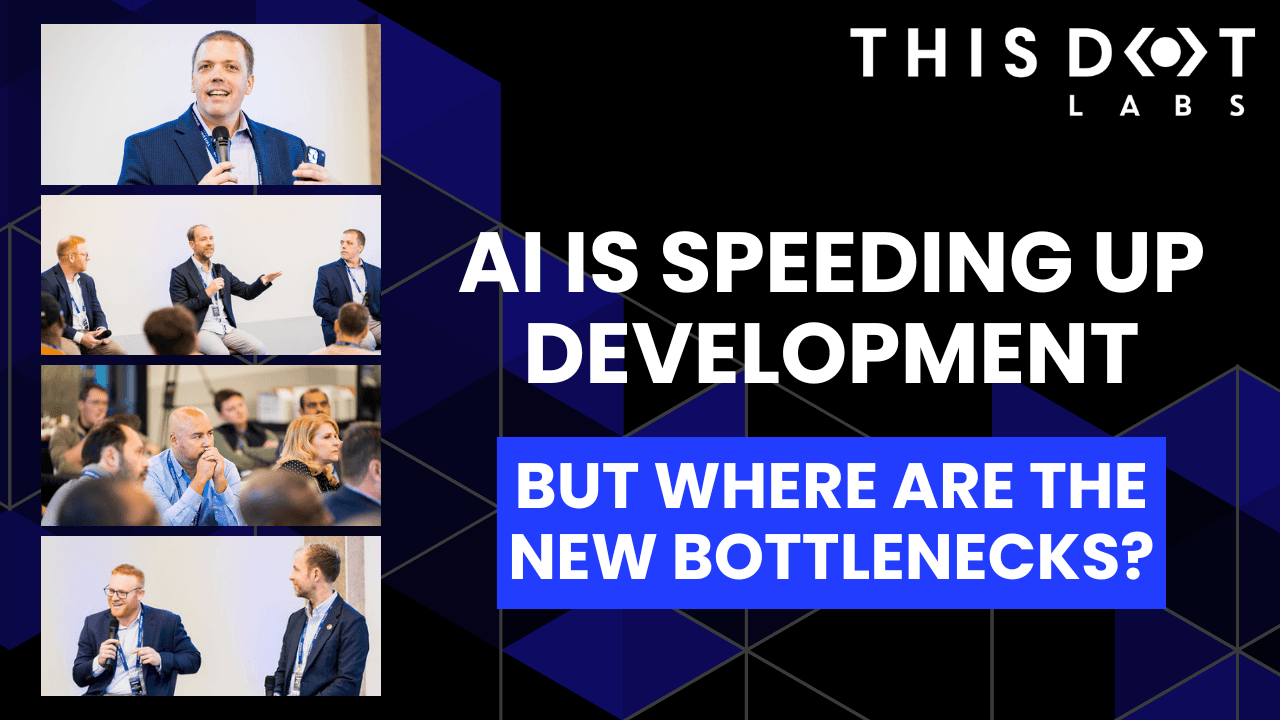
AI Is Speeding Up Development. But Where Are the New Bottlenecks?

AI is accelerating development, but it’s also exposing everything else that’s broken. At the Leadership Exchange, leaders unpacked how AI is reshaping the SDLC and what organizations need to address beyond just coding to make adoption successful. Moderated by Rob Ocel, VP of Innovation at This Dot Labs, the panel featured Itai Gerchikov at Anthropic and Harald Kirschner, Principal Product Manager for GitHub Copilot & VS Code at Microsoft. Panelists explored the current state of AI adoption across the software development lifecycle and shared practical insights into how organizations can effectively integrate AI tools. Panelists discussed how companies are investing in AI tools, skills, and managed competency programs to support developers. While AI can dramatically accelerate coding, the panel emphasized that adoption affects every stage of the SDLC. Bottlenecks now appear in testing, DevOps, product delivery, and marketing as AI speeds up development. Organizations that address technical debt and process inefficiencies are better positioned to extract maximum value from AI tools. The conversation also focused on opportunities and risks. Security, governance, and workforce education were highlighted as critical factors for adoption. Panelists stressed that AI initiatives should be aligned with broader business goals rather than pursued in isolation. They noted that companies experimenting at the cutting edge need to consider organizational readiness just as carefully as technical capabilities. Panelists also explored how leading organizations are navigating the early stages of adoption. Those ahead of the curve are using structured experimentation, prioritizing process improvements, and continuously evaluating outcomes to refine their AI strategies. Learning from these early adopters allows other organizations to anticipate emerging trends and prepare for the next phase of AI adoption rather than simply replicating past approaches. Key Takeaways Investing in AI skills and tools should be done thoughtfully, with clear alignment to business objectives. Examining the full SDLC helps identify bottlenecks that AI may accelerate or expose. Organizations can gain a competitive advantage by learning from early adopters and planning for where AI adoption is heading. AI adoption is not just a technical initiative; it is a strategic transformation that requires attention to people, process, and technology. Organizations that balance innovation with operational discipline will be best positioned to capture the full potential of AI across the software lifecycle. Seeing similar challenges in your own SDLC? Let’s compare notes. Join us at an upcoming Leadership Exchange or reach out to continue the conversation. Tracy can be reached at tlee@thisdot.co....

Calypso Hernandez2 mins
AI AdoptionAILeadership ExchangeEngineering Leadership

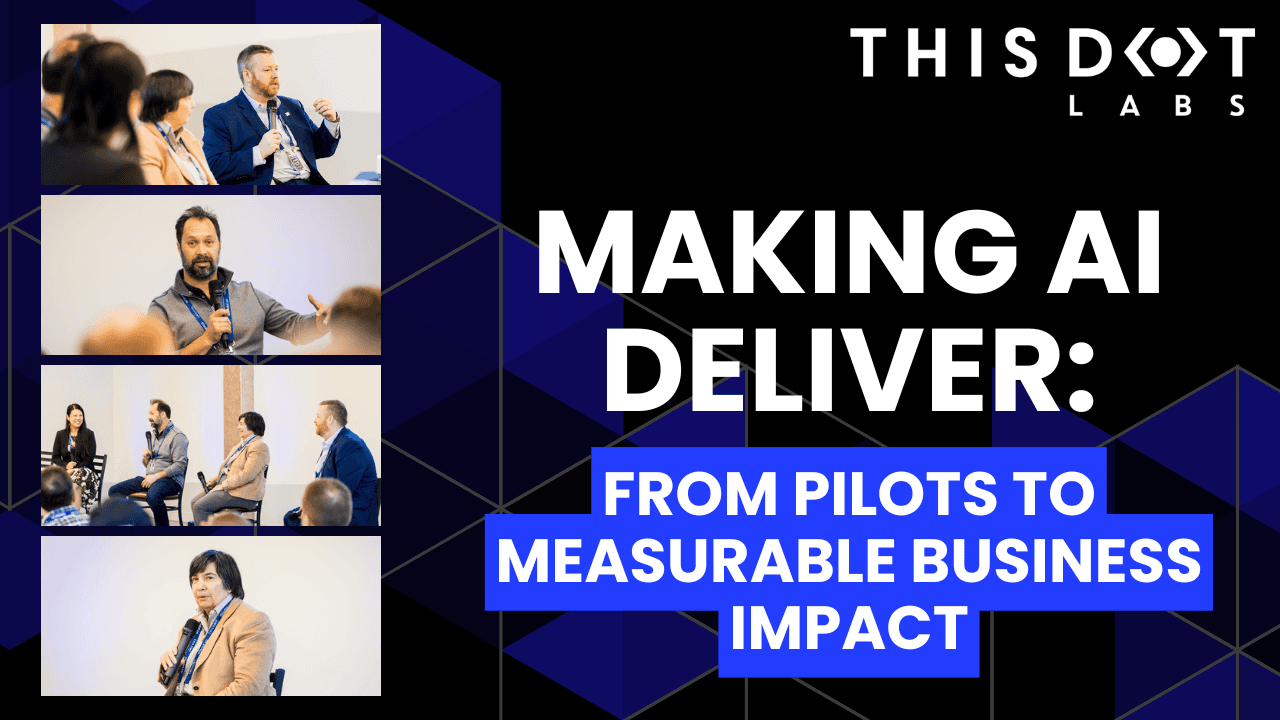
Making AI Deliver: From Pilots to Measurable Business Impact

A lot of organizations have experimented with AI, but far fewer are seeing real business results. At the Leadership Exchange, this panel focused on what it actually takes to move beyond experimentation and turn AI into measurable ROI. Over the past few years, many organizations have experimented with AI, but the challenge today is translating experimentation into measurable business value. Moderated by Tracy Lee, CEO at This Dot Labs, panelists featured Dorren Schmitt, Vice President IT Strategy & Innovation at Allen Media Group, Greg Geodakyan, CTO at Client Command, and Elliott Fouts, CAIO & CTO at This Dot Labs. Panelists discussed how companies are moving from early AI experiments to initiatives that deliver real results. They began by examining how experimentation has evolved over the past year. While many organizations did not fully utilize AI experimentation budgets in 2025, 2026 is showing a shift toward more intentional investment. Structured budgets and clearly defined frameworks are enabling companies to explore AI strategically and identify initiatives with high potential impact. The conversation then turned to alignment and ROI. Panelists highlighted the importance of connecting AI projects to corporate strategy and leadership priorities. Ensuring that AI initiatives translate into operational efficiency, productivity gains, and measurable business impact is essential. Companies that successfully align AI efforts with organizational goals are better equipped to demonstrate tangible outcomes from their investments. Moving from pilots and proofs of concept to production was another major focus. Governance, prioritization, and workflow integration were cited as essential for scaling AI initiatives. One panelist shared that out of nine proofs of concept, eight successfully launched, resulting in improvements in quality and operational efficiency. Panelists also explored the future of AI within organizations, including the potential for agentic workflows and reduced human in the loop processes. New capabilities are emerging that extend beyond coding tasks, reshaping how teams collaborate and how work is structured across departments. Key Takeaways Structured experimentation and defined budgets allow organizations to explore AI strategically and safely. Alignment with business priorities is essential for translating AI capabilities into measurable outcomes. Governance and workflow integration are critical to moving AI initiatives from pilot stages to production deployment. Successfully leveraging AI requires a balance between experimentation, strategic alignment, and operational discipline. Organizations that approach AI as a structured, measurable initiative can capture meaningful results and unlock new opportunities for innovation. Curious how your organization can move from AI experimentation to real impact? Let’s talk. Reach out to continue the conversation or join us at an upcoming Leadership Exchange. Tracy can be reached at tlee@thisdot.co....

Calypso Hernandez2 mins
AI AdoptionAILeadership ExchangeEngineering Leadership