Javascript

10 Mobile AR Apps That Are Creating the “New Normal” for Your Customers

This Dot
7 min read
10 Mobile AR Apps That Are Creating the “New Normal” for Your Customers
This article was written over 18 months ago and may contain information that is out of date. Some content may still be relevant, but please refer to official documentation for the latest information.

As developers and businesses leaders, we know that augmented reality is no longer a far-flung futuristic concept. In fact, a 2019 Perkins Coie survey revealed that roughly 90% of tech leaders and consultants believe that the use of immersive technologies will be as ubiquitous as mobile devices by 2025. But more intriguing than this, is the diversity in opinions from respondents when asked which sectors they believed would most invest in AR/VR technologies. Not surprisingly, 54% include gaming in their top picks. But that narrow majority is rivaled by 43% of respondents who include healthcare, and at least 20% who felt strongly about a number of other industries, including education, military and defense, and manufacturing/automotive.

Though the use of AR technologies is expected to explode across the consumer user-base, only 22% of consumers, in a 2019 ARtillery Intelligence survey, were aware of having used mobile AR technologies themselves. Now it may just be one dev’s opinion, but I believe that this number does not accurately reflect the true percentage of those surveyed who have actually used AR- just the percentage that KNOW they’ve used AR.

But is this number important?

I think so.

I imagine that the unknown percentage that claimed not to have used mobile AR apps, but who have unknowingly used them, likely just stumbled upon them, not drawn to the fact that the applications utilize this transformative technology, and being completely oblivious that they used AR. This unknown should terrify, or motivate executives, because this may mean that AR is so quickly and seamlessly integrating with other mobile technologies, that the change is completely inarticulable at best, and unnoticed at worst, by the average consumer.

In other words, AR may be quickly becoming the new normal, with unintegrated technologies possibly being seen by consumers not as a different class of technologies, but, perhaps, as an “inferior” technology.

So let’s check out 10 mobile apps that are already preparing your future customers and users for the “new normal”:

  1. Wecasper

Launched in 2015, Wecasper is a mobile social media application that allows its users to store multimedia content in geolocated containers, almost like time capsules, aptly called “caps”. But not only does this app allow users to interact with certain content while in particular locations, it also lets users search for, and see the caps in their environments through their mobile screens!

  1. WallaMe

Not so unlike Wecasper, WallaMe have given users the ability to hide messages in the real world, and share those messages with their friends, and the general public. Users can draw pictures, or paint messages on physical walls around them- almost like virtual graffiti- and then alert their friends about the message’s location! Friends are then able to see the messages they leave for each other, and even share those messages with other users!!

  1. Pottery Barn’s 3D Room View App

Ever been on the verge of buying that stylish chair, or perfect coffee table, but just don’t know how it would look in your living room? Pottery Barn is one of a number of furniture retailers, including my favorite, Ikea, that have launched AR powered retail platforms. With their 3D Room View App, users are now able to place spatially accurate renderings of Pottery Barn’s catalog of furniture to see how the pieces fit their rooms. Customers never need to doubt their online purchases, and Pottery Barn will undoubtedly see an increase in engagement with their ecommerce platforms.

  1. Sherwin William’s ColorSnap Visualizer

It seems Pottery Barn isn’t the only home decor and improvement company that has caught the AR bug. Industrial paint company, Sherwin Williams is giving their customers the ability to try out colors without having to pick up swatches, or dab unsightly (and let’s be honest, unhelpful) brush strokes on to their walls. Instead, customers can actually project colors onto their very own walls through a mobile interface, giving them the ability to try out hundreds of different colors in just minutes.

  1. Star Walk 2

Developed by Vito Technologies, Star Walk 2 is a fun educational application that guides users through the night’s sky. All a user has to do is point their phone toward the sky, and the app’s AR feature will not only tell the user what stars, constellations, and other astronomical features are above, but will show them as well! No more guessing at what constellations are what, or if that little light above is a star or an airplane- users can trust Sky Walk 2’s AR feature to tell them everything they want to know, and probably a little more! Sappy high school dates will never be the same!

  1. MeasureKit

Now I know that I’m not the only one who is CONSTANTLY misplacing the one measuring tape we keep around the house. That’s where MeasureKit swoops in for the rescue. MeasureKit uses advanced AR technologies to allow its users to quickly and accurately measure lengths, distances, trajectories, and angles with nothing more than the camera on their mobile devices. I would download this is a second if it didn’t make me so afraid of misplacing my Smart Phone too!

  1. The Safety Compass

Now let’s take a quick diversion from consumer apps, and look at a mobile app being used to help keep industrial work sites safer for employees. According to the app’s publisher, an employee dies on a worksite every 15 seconds, globally. The Safety Compass is hoping to decrease that number significantly with its mobile app that gives workers the ability to scan their worksites for potential hazards, and shows them relevant information on standard safety protocols with which to approach the hazards. This takes the guess-work out of not only whether something is hazardous, but what that hazard is called, equipping workers with relevant information that will help keep them safe.

  1. Janus Health AR

Janus Health is changing the future of dentistry and orthodontics with its mobile compatible AR application. The app scans a patient’s teeth, and shows them, in real-time, what their teeth could look like after a procedure. This not only boosts patient confidence, but may also expediate the consultation process for providers, and increase patient engagement with the practice. I wonder if the app can make your teeth look worse too? Maybe if my orthodontist had this app when I was a teenager, I would have actually worn my retainer!

  1. Google Lens

Google Lens, for Android (sorry iOS users), brings the power of advanced image recognition software to the palm of its user’s hand. Have you ever taken a walk through the park, and wanted to identify what kind of tree or flower is in front of you? Now all you need to do is point your mobile camera toward it, and Google Lens will identify it for you! But that’s not all it does! Google advertises that users can also translate text from signs or packages, scan restaurant menus to find pictures and reviews of the items, and even find out more information about landmarks just by pointing their mobile cameras!

  1. Quiver

Quiver is an AR enhanced edutainment mobile app that helps bring kids’ drawings to life! Users simply need to print off the pages offered through the company’s web platform or app, color in the photos, and use a mobile device to see lifelike 3-D renderings of the pictures right in front of them! Quiver has also expanded, releasing new product lines, including a version of their app that provides all of the fun of coloring, and AR, with a greater focus on education!

SO WHAT'S THE TAKE AWAY?

According to Perkins Coie, the North American market is expected to see the most significant growth in AR investment over the next 5 years. While the language of AR is not necessarily on the forefronts of consumers’ minds, the pressure to provide these more natural connections between the digital world and consumers will increase as more users come to expect AR integrated application functionalities.

Now is a perfect time to invest in AR technology! Whether you are looking to engage more with your customers, improve the lives of your employees, or simply create a product that will enrich users' lives through play and learning, there is space for AR integrated mobile applications within your company. By starting your transformation now, you are affording your company the opportunity to identify the areas of your business that can best be enhanced by this and other transformative technologies, and make mindful, well considered steps to developing these technologies for yourself.

Do not wait until the pressure from your competitors eventually forces you to hurry a product to market. Begin the process now, and you will thank yourself later.

Don’t know how to start?

Contact This Dot Labs to speak with leaders in enterprise-level digital transformation. This Dot Labs is a web development firm that helps some of the world’s leading enterprises, including American Express, ING, Groupon, and many others, reach their development goals through consulting, mentorship, and training. With our diverse team of seasoned senior developers and mentors, we can help you harness the power of advanced modern tools to keep you ahead of the AR curve!

About the author

This Dot

This Dot

Keep reading

View all posts →

This Dot AI Field Notes - Anatomy of a Coding Harness

A coding agent is not magic, it’s a loop. We call this a harness. The harness is a deterministic layer of code that wraps an LLM....

1 min
AI

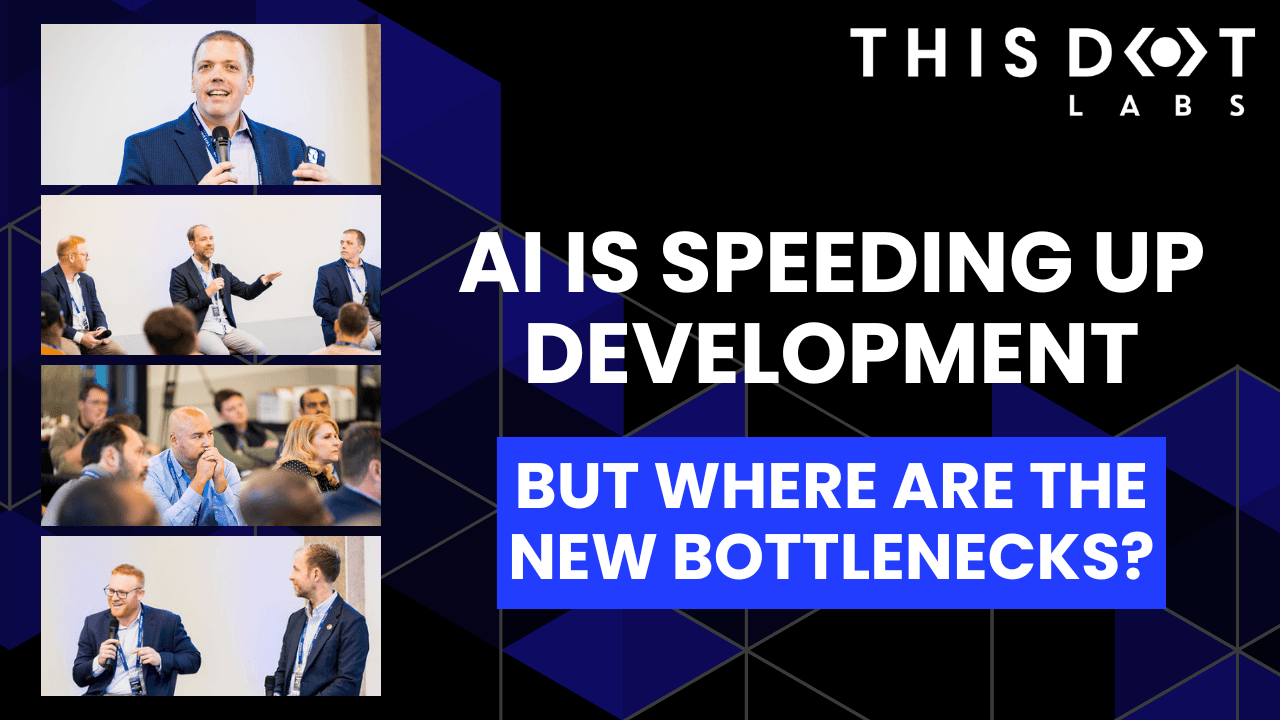
AI Is Speeding Up Development. But Where Are the New Bottlenecks?

AI is accelerating development, but it’s also exposing everything else that’s broken. At the Leadership Exchange, leaders unpacked how AI is reshaping the SDLC and what organizations need to address beyond just coding to make adoption successful. Moderated by Rob Ocel, VP of Innovation at This Dot Labs, the panel featured Itai Gerchikov at Anthropic and Harald Kirschner, Principal Product Manager for GitHub Copilot & VS Code at Microsoft. Panelists explored the current state of AI adoption across the software development lifecycle and shared practical insights into how organizations can effectively integrate AI tools. Panelists discussed how companies are investing in AI tools, skills, and managed competency programs to support developers. While AI can dramatically accelerate coding, the panel emphasized that adoption affects every stage of the SDLC. Bottlenecks now appear in testing, DevOps, product delivery, and marketing as AI speeds up development. Organizations that address technical debt and process inefficiencies are better positioned to extract maximum value from AI tools. The conversation also focused on opportunities and risks. Security, governance, and workforce education were highlighted as critical factors for adoption. Panelists stressed that AI initiatives should be aligned with broader business goals rather than pursued in isolation. They noted that companies experimenting at the cutting edge need to consider organizational readiness just as carefully as technical capabilities. Panelists also explored how leading organizations are navigating the early stages of adoption. Those ahead of the curve are using structured experimentation, prioritizing process improvements, and continuously evaluating outcomes to refine their AI strategies. Learning from these early adopters allows other organizations to anticipate emerging trends and prepare for the next phase of AI adoption rather than simply replicating past approaches. Key Takeaways Investing in AI skills and tools should be done thoughtfully, with clear alignment to business objectives. Examining the full SDLC helps identify bottlenecks that AI may accelerate or expose. Organizations can gain a competitive advantage by learning from early adopters and planning for where AI adoption is heading. AI adoption is not just a technical initiative; it is a strategic transformation that requires attention to people, process, and technology. Organizations that balance innovation with operational discipline will be best positioned to capture the full potential of AI across the software lifecycle. Seeing similar challenges in your own SDLC? Let’s compare notes. Join us at an upcoming Leadership Exchange or reach out to continue the conversation. Tracy can be reached at tlee@thisdot.co....

Calypso Hernandez2 mins
AI AdoptionAILeadership ExchangeEngineering Leadership

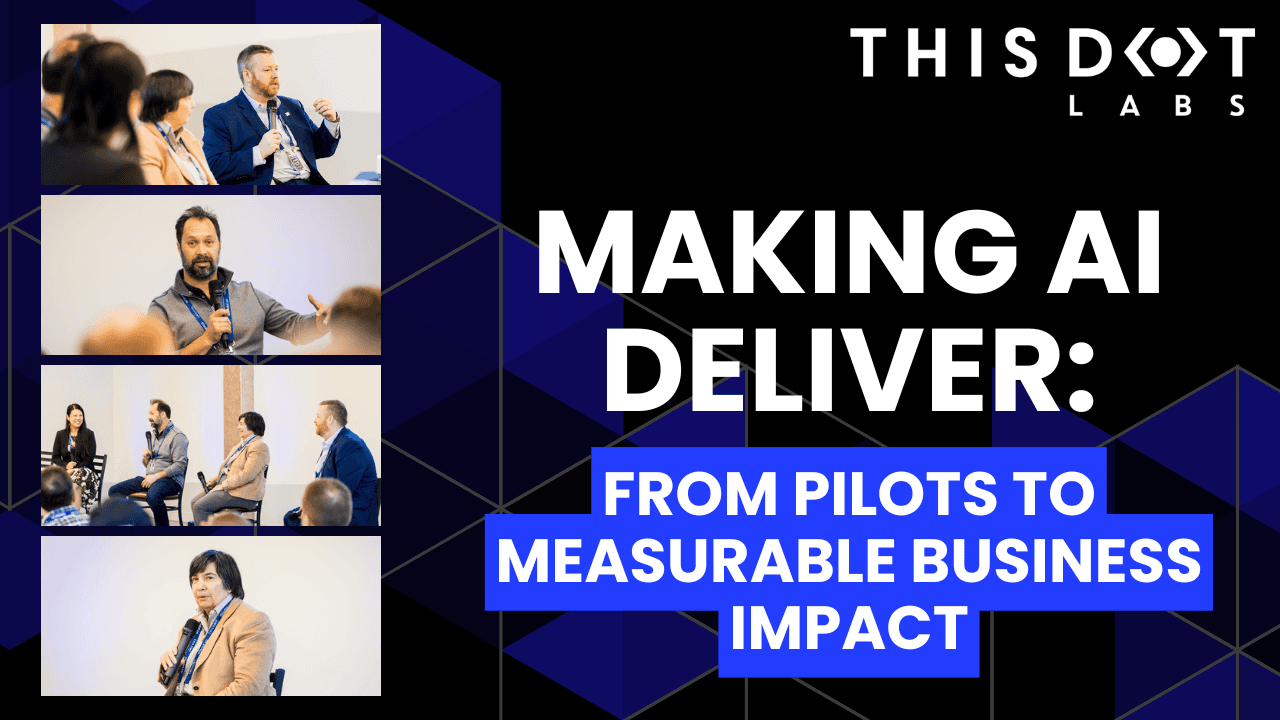
Making AI Deliver: From Pilots to Measurable Business Impact

A lot of organizations have experimented with AI, but far fewer are seeing real business results. At the Leadership Exchange, this panel focused on what it actually takes to move beyond experimentation and turn AI into measurable ROI. Over the past few years, many organizations have experimented with AI, but the challenge today is translating experimentation into measurable business value. Moderated by Tracy Lee, CEO at This Dot Labs, panelists featured Dorren Schmitt, Vice President IT Strategy & Innovation at Allen Media Group, Greg Geodakyan, CTO at Client Command, and Elliott Fouts, CAIO & CTO at This Dot Labs. Panelists discussed how companies are moving from early AI experiments to initiatives that deliver real results. They began by examining how experimentation has evolved over the past year. While many organizations did not fully utilize AI experimentation budgets in 2025, 2026 is showing a shift toward more intentional investment. Structured budgets and clearly defined frameworks are enabling companies to explore AI strategically and identify initiatives with high potential impact. The conversation then turned to alignment and ROI. Panelists highlighted the importance of connecting AI projects to corporate strategy and leadership priorities. Ensuring that AI initiatives translate into operational efficiency, productivity gains, and measurable business impact is essential. Companies that successfully align AI efforts with organizational goals are better equipped to demonstrate tangible outcomes from their investments. Moving from pilots and proofs of concept to production was another major focus. Governance, prioritization, and workflow integration were cited as essential for scaling AI initiatives. One panelist shared that out of nine proofs of concept, eight successfully launched, resulting in improvements in quality and operational efficiency. Panelists also explored the future of AI within organizations, including the potential for agentic workflows and reduced human in the loop processes. New capabilities are emerging that extend beyond coding tasks, reshaping how teams collaborate and how work is structured across departments. Key Takeaways Structured experimentation and defined budgets allow organizations to explore AI strategically and safely. Alignment with business priorities is essential for translating AI capabilities into measurable outcomes. Governance and workflow integration are critical to moving AI initiatives from pilot stages to production deployment. Successfully leveraging AI requires a balance between experimentation, strategic alignment, and operational discipline. Organizations that approach AI as a structured, measurable initiative can capture meaningful results and unlock new opportunities for innovation. Curious how your organization can move from AI experimentation to real impact? Let’s talk. Reach out to continue the conversation or join us at an upcoming Leadership Exchange. Tracy can be reached at tlee@thisdot.co....

Calypso Hernandez2 mins
AI AdoptionAILeadership ExchangeEngineering Leadership

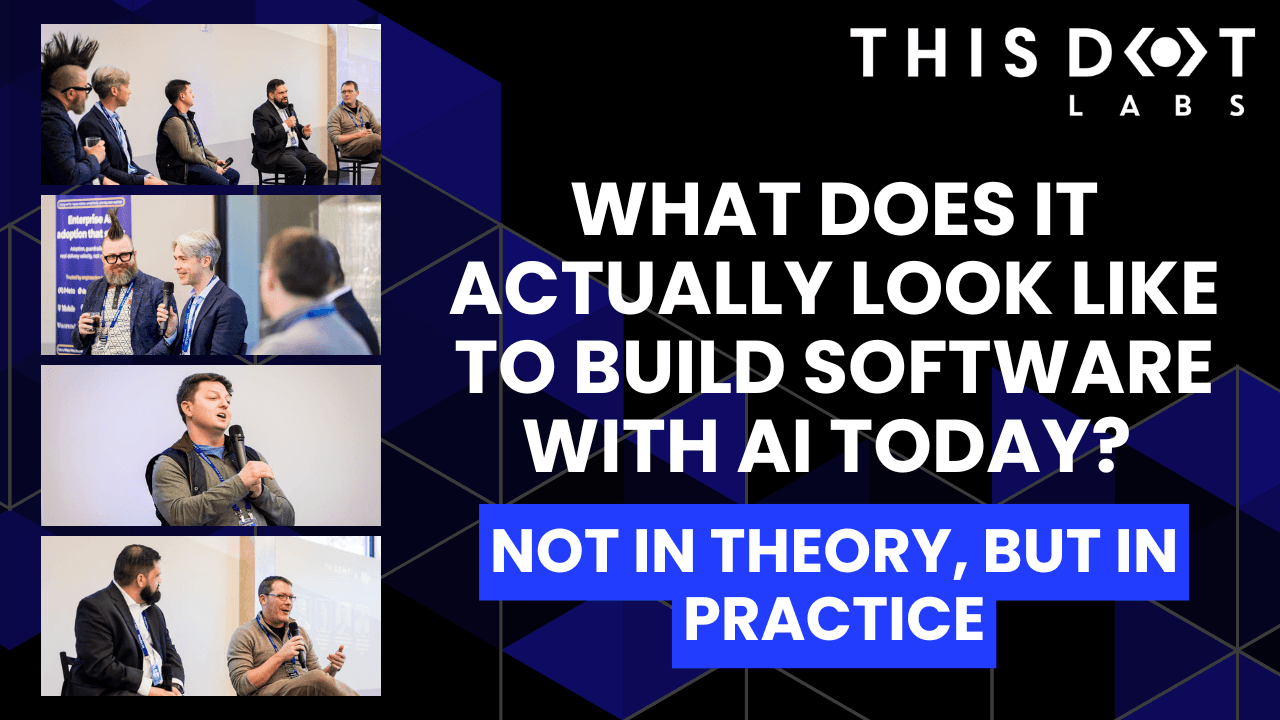
What does it actually look like to build software with AI today? Not in theory, but in practice.

What does it actually look like to build software with AI today? Not in theory, but in practice. At the Leadership Exchange, this was the question at the center of the Developer Panel, where leaders from across the industry unpacked what’s really changing inside engineering teams and what organizations need to do right now to keep up. The Developer Panel at the Leadership Exchange explored the cutting edge of AI in software engineering and examined what organizations should focus on today to prepare for the future. Moderated by Jeff Cross, Co Founder & CEO at Nx, the panel featured Victor Savkin, Cofounder & CTO at Nx, Alex Sover, Vice President of Engineering at OpenAP, Brent Zucker, Senior Director of Engineering at Visa, and Jonathan Fontanez, AI Engineering Lead at This Dot Labs. Panelists shared insights into how AI is transforming the software development lifecycle and how teams can adopt tools effectively while preparing for organizational change. Panelists discussed emerging workflows, including CI in the loop, agentic healing, and context engineering. They examined how validation, code reviews, and PRDs are evolving alongside AI capabilities and how teams are integrating external sources such as production traces to improve quality and reliability. The discussion also covered what the next generation of agentic tools might look like and how these capabilities will shape engineering practices in the near future. Adoption of AI comes with challenges. Teams often rely on plugins or extensions without foundational understanding, and individual contributors may fear displacement. Panelists emphasized that education, governance, and skill building are essential for teams to manage AI agents effectively while maintaining quality. They also highlighted the need to standardize workflows and ensure organizational alignment to fully leverage AI capabilities. The conversation extended beyond technical challenges to organizational implications. Panelists discussed how teams can avoid issues like Conway’s Law, manage distributed teams effectively, and evolve engineering practices alongside AI adoption. Leadership and management strategies play a crucial role in ensuring that AI integration delivers meaningful outcomes while maintaining efficiency and alignment with business objectives. Key Takeaways AI workflows require both technical and organizational preparation. Education, governance, and skill development are essential for successful implementation. Forward looking teams are rethinking validation, CI pipelines, and context management to fully leverage agentic AI. The discussion highlighted that adopting AI at the cutting edge is not just about new tools it is about rethinking processes, workflows, and organizational culture. Companies that embrace this holistic approach are most likely to succeed in leveraging AI to its full potential. Are you interested in more conversations like this? Message us for an invite to the next, or for a private discussion around these topics. Tracy can be reached at tlee@thisdot.co....

Calypso Hernandez2 mins
AI AdoptionAILeadership ExchangeEngineering Leadership